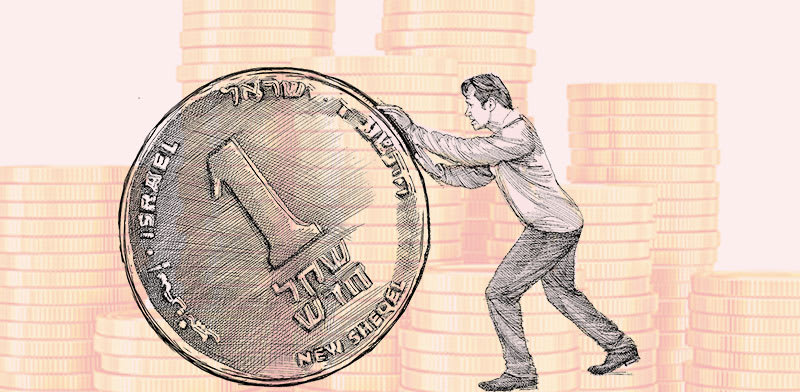
The shekel continues to strengthen against the US dollar. Expectations of an improvement in the geopolitical situation, along with the weakness of the dollar on world markets due to the strengthening of the Japanese yen, are the two main trends supporting the Israeli currency’s appreciation.
Strongest for four years
The dollar is trading at levels against the shekel not seen for about four years. On Tuesday, the Bank of Israel set the shekel-dollar exchange rate down 1.052% at NIS 3.104/$. Since the start of 2026, the shekel has appreciated by about 2% against the dollar, and in the last three years it has appreciated by about 10%. The shekel has strengthened by about 23% against the US dollar since it traded at NIS 4.05/$ following the outbreak of the war in October 2023.
The US dollar’s weakness can also be seen on global markets, especially against the Japanese yen. Over the past week, the dollar has weakened by about 2.4% against the yen.
Bank Leumi head of markets strategy Kobby Levi explains that an exceptional event occurred last weekend, which supported the depreciation of the US dollar. He says, “As part of the event, the yen strengthened sharply amid rumors of intervention by the Japanese government, and at the same time, the New York Federal Reserve conducted a rate check – a move that may indicate a willingness to act in the foreign exchange market.”
Levi adds, “Despite these being rumors, there is great alertness in the market, since combined activity by the Federal Reserve and the Japanese government to support the appreciation of the yen is an exceptional and quite significant event, which, if it did happen, may indicate the Fed’s openness to actively support the depreciation of the dollar, a fairly significant change in the global monetary context.”
As for the shekel, Levi notes that in the past year it has been strengthening consistently against the basket of currencies, and even recently reached an all-time high. Levi explains that this is a combination of an improvement in geopolitical sentiment and strong fundamental forces: a current account surplus, a surplus of assets over liabilities in foreign currency, the hedging policy of institutional entities and a positive capital flow to Israel.
If the exchange rate breaks below NIS 3.07/$, then the shekel will be at a strength not seen since the 1990s. The DXY index, which reflects the strength of the dollar against the world’s major currencies, also fell by about 2% in the past week and has lost about 2.8% in the past six months.
More exposure to foreign currency
Mizrahi Tefahot Bank chief markets economist Ronen Menachem explains that the weakening of the dollar on world markets reflects, among other things, the tensions between the US and Europe and Canada, the discourse around the independence of the Fed and the expectation of further interest rate cuts in the US. Menachem observes that this is an ongoing process and not a one-off event. He says, “US stock indices are rising and the shekel tends to strengthen against the dollar in response. This is because this leads to overexposure of local entities to foreign exchange/stocks overseas and forces, once again, the conversion of dollars into shekels.”
RELATED ARTICLES
“The shekel could strengthen to NIS 2/$”
According to Menachem, another reason for the shekel’s strengthening can be attributed to political moves and the apparent transition from stage A to stage B, while the US’s involvement and interest in advancing the process are clear and provide a certain level of security for investors.”
Bank Hapoalim chief financial markets strategist Modi Shafrir has identified this trend for a long time. He notes that since November 2024, the bank has recommended a long position on the shekel. He adds, “We still think today that the shekel is expected to continue strengthening, although likely at a more moderate pace than in the past six months. There are fundamental forces that support the shekel, including the excess of funds entering the country over those leaving. Exports are greater than imports, and there are also huge investments by foreign entities in Israel, mainly in high-tech.”
But there were elements that offset the effect of the strengthening of the shekel against the dollar and the basket of currencies between 2022-2024, explains Shafrir, including institutional investors who bought nearly $35 billion in those years. Shafrir also recounts, “The public itself increased its exposure to foreign exchange, through the entire investment trend in the S&P500. Before that, in 2020-2021, the Bank of Israel was a factor, buying $56 billion in a two-year period.”
Shafrir estimated throughout the period that even when the shekel began to strengthen, institutional investors would not continue to increase their exposure to foreign exchange. He says, “In addition, in the trading room of Bank Hapoalim, they estimate that they will reduce their exposure and sell dollars. And so, according to the data for the first three quarters of 2025 published by the Bank of Israel so far, we saw that institutional investors sold $7.5 billion. To this must be added the positive trend on the Nasdaq (there is a historical correlation that shows that the shekel strengthens as the Nasdaq gains).
Will the shekel continue strengthening?
Shafrir believes that the fundamental forces support a strong shekel, because there is a major increase in investments in the economy. “I don’t see the institutions currently increasing their exposure to foreign exchange too much. The annual inflation rate is expected to reach close to the lower limit of the target in 2026, which means that the Bank of Israel will probably start thinking about buying dollars (to weaken the shekel). Governor Amir Yaron also said in the latest interest rate decision that the bank may intervene in foreign exchange to prevent inflation from falling too much. On the other hand, he does not want to subsidize exporters but is concerned about price stability.”
Those who are particularly affected by the strong shekel are exporters, including defense companies that are currently enjoying a wave of orders, but operate with low profitability compared to high-tech. Most orders are denominated in foreign exchange, so the appreciation hurts revenue in shekel terms, although many companies hedge the risk through foreign exchange deals.
Published by Globes, Israel business news – en.globes.co.il – on January 27, 2026.
© Copyright of Globes Publisher Itonut (1983) Ltd., 2026.