One thing has been consistently true about the investment marketing business, at least for as long as I’ve been paying attention (30 years or so): People love IPOs.
Initial Public Offerings (IPOs), the most common mechanism through which private companies raise money on the stock market and become listed and publicly traded, represent “new,” in a world where everyone always wants the latest model, and they seem attractively restrictive (since it’s often hard to get an allocation at the IPO price, your broker has to like you, which usually means you waste a lot of money on commissions=)… and for a lot of people, IPOs carry the promise of the future, perhaps representing the next big thing. Everybody wants to be one of the first buyers of the next Apple (IPO 45 years ago, at $22… or split-adjusted, ten cents), or the next NVIDIA (which went public 27 years ago, at $12 — split-adjusted, that would now be 25 cents). That’s what dreams are made of.
And that’s even though we know, objectively, that the average IPO is no better than the average established publicly traded company… and a newly public stock is often worse than the average. stock… it’s the ultimate stock-picking hubris that we can not only identify the best company on the public markets, but we can also identify the best company that hasn’t yet gone public (as with all things, “Best” doesn’t often mean “Most well-known”). And know which of the firms that do go public are worth buying, either to hold for decades or just to trade because it’s super popular at first. Just for some context, Apple was the biggest IPO since Ford when they came public in 1980, but NVIDIA was largely a small niche company and a mildly popular afterthought in the IPO-mad year of 1999, which included initial offerings from dominant companies and long-term survivors like Goldman Sachs, UPS, Charter Communications and Priceline.com (now Booking.com), along with tons of crappy dot-com stocks that jumped 500% on their first day of trading but disappeared by 2002.
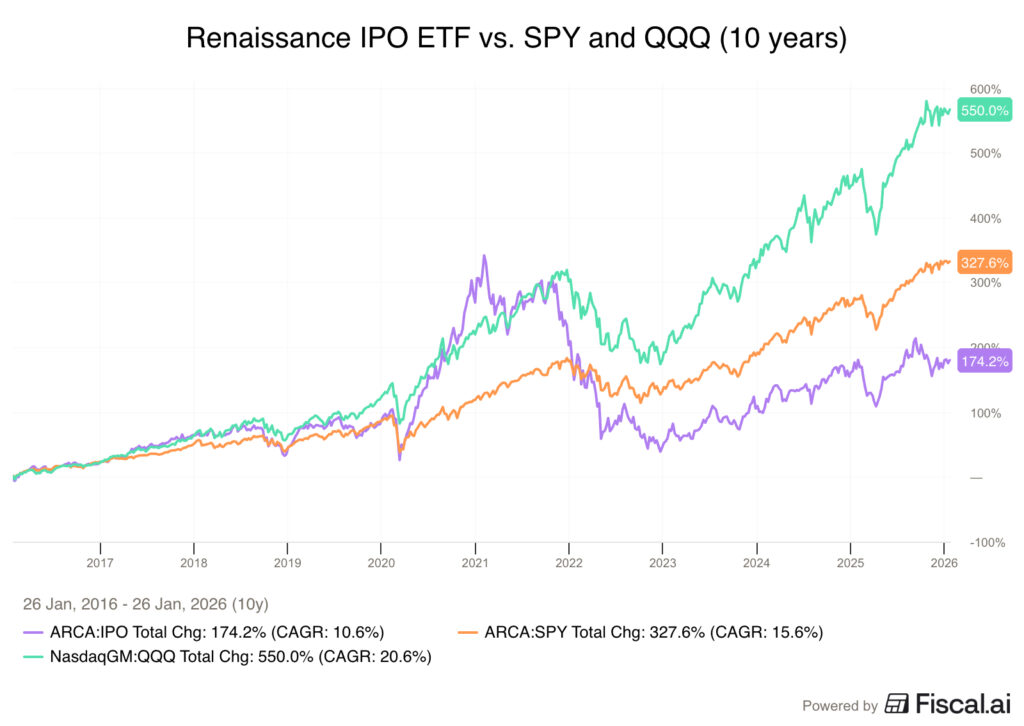
There’s not a great way to track IPOs or “companies about to go public” as an asset class, but the best representation of the group is probably the Renaissance IPO ETF (ticker is IPO, naturally), which buys newly trading companies in the days after their IPO and holds them for 2-3 years. And you can see that it acts essentially like a magnified bet on investor sentiment, as you’d expect for “new companies”… but what it doesn’t usually do is “beat the market.”
Still, just like the public markets, the private markets can bring both success and failure — and unlike the public markets, we can daydream about “coming soon” hot IPOs with reckless abandon, because we don’t even know, usually, what the financials look like for those companies, or how they’re doing operationally in any real way, at least not until we get their first real S-1 filings as they prepare to go public.
Buying into a “pre-IPO” story is the ultimate “story stock” investment, most investors will never read the S-1 or know much about the financials before becoming excited about a sexy new company, so the performance is even more than usual about how investors feel about the idea of a company and the public image of a company, without the messy stuff like operating expenses or capital needs or stock-based compensation or, indeed, whether or not the company is or will ever be a profitable enterprise. That stuff comes later, after the heavily marketed IPO, which is usually also priced low to generate quick gains on the first day and gin up yet more excitement… but the pre-IPO times for hot “story stocks” are often, for most people, just a time of unconstrained dreams of what a company and stock could someday become.
Over the past year, there have essentially been three big “rumor” companies in pre-IPO land: OpenAI, Anthropic, and SpaceX, all of which have raised billions of dollars privately and are thinking, we’re told, about going public. In part because the growth that all three of those firms envision and promise, to build the next wave of AI and put colonies on Mars (or, perhaps, AI data centers in space), will require massive capital investment. (And, of course, because employees and early investors want to sell some shares — which you can do privately, but can do much more easily, and at larger volume, in the public markets… it’s worth remembering that venture investors and founders often think of an IPO as the “exit,” so the stock market is providing exit liquidity. Sometimes it’s a win-win, but the venture investors and founders always win first).
By far the most mature of those stories is SpaceX, founded by Elon Musk in 2002 with some of his PayPal fortune (a couple years before Musk first invested in Tesla, interestingly enough). They’ve reportedly raised $12 billion or so since then from outside investors, in dozens of funding rounds, and we’ve covered these rumors and “pre-IPO back door” ways to buy SpaceX shares a few times since it became the most richly valued and arguably the most liquid private company back in 2020 (taking that slot from Palantir, I’d say). A year ago, the stories were all about SpaceX spinning off Starlink, their low earth orbit (LEO) satellite broadband network, but these days the inclination of Elon Musk seems to be to keep Starlink as a subsidiary of SpaceX and take the whole thing public through a larger IPO, in part because splitting it off would starve SpaceX of its steadiest revenue stream.
There has been no formal move toward a SpaceX IPO, they have not yet filed an S-1 with the SEC to really start that process, or even publicly acknowledged that they’ve hired an investment bank to help them prepare for that S-1, but recent news reports quoted “sources” as saying that SpaceX has approached most of the big investment banking firms to start conversations about going public, perhaps as early as this year.
And lots of bankers and SpaceX folks must be talking to somebody, because there are pretty constant rumors about them wanting to achieve a valuation of $1.5 trillion with this IPO… and that sends sparks of lust flying among investors, because the last valuation, in secondary sales (mostly by employees) in December, was about $800 billion (and previous raises were done at a $400 billion valuation last Summer, and $350 billion in late 2024), so if you can “buy in” at the current valuation, maybe you’ll get a near-100% return if there’s really an IPO soon at that $1.5 trillion value. Even though, yes, the limited information we’ve seen indicates that revenue for SpaceX was in the $15 billion neighborhood in 2025, and will probably grow by 30-50% in 2026, mostly driven by Starlink… so that’s potentially a trailing valuation of 100X sales.
This is Elon Musk we’re talking about, and a cool company in a fun sector (spaceships!) that has done extraordinary things, so hyperbole and exaggerated valuations are no surprise — but who knows, maybe they really will be the first company to go public at a trillion+ dollar valuation.
But for comparison, arguably the hottest new public company of 2020, and before that for many years the hottest private company that was pitched as a “pre-IPO” investment by a number of newsletters in the pre-COVID era, was Palantir — and they went public at “only” about 15-20X sales, and later got cut in half, trading below that first-day IPO price for almost four years before investors really fell in love with the improving financials and their shift to a heavier focus on commercial customers in mid-2024.
Palantir has obviously worked out extremely well for anyone who bought it either before going public, or really at any time during its first few years as a public company, though that would have required holding through several years of very weak performance to get to the huge gains PLTR has shown over the past year or so, and many investors aren’t willing to be that patient. Especially if they were daydreaming about day one IPO riches.
Big private companies with high-profile leaders and exciting and thematic stories always attract attention, and sometimes those do become even larger global leaders over time… but they aren’t always great investments. Getting in early, often before they’re profitable, and at prices that are often driven entirely by future potential, with no real disclosures or proven profitability, is inherently risky. The hottest pre-Palantir IPOs for retail investors in the past 15 years or so, the ones that generated a lot of “pre-IPO backdoor” teaser pitches or excitement, were probably Facebook (now Meta) in 2012, and Twitter (now X) a year later, and both traded well below their “private pre-IPO valuation” at times in their early years.
The counterpoint, of course, is that everything Elon Musk touches turns to gold, (and yes, I can hear you in the back saying, “at least for him!”).
And that brings out all the newsletter ads… we’ve seen a variety of “get in before the IPO” and “SpaceX Backdoor” promos from Jeff Brown, James Altucher, Ian Wyatt, and, frankly, most of the other usual suspects. They’re all promising either a way to invest directly in SpaceX, through a private purchase on one of the various private sale platforms, or a way to invest indirectly, through a company they believe will be a Starlink or SpaceX supplier (or acquisition), or through a fund or ETF that has purchased a meaningful position in SpaceX shares.
And I’m not going to dig into all of those teaser ads, some of which are promotions that are really over a year old and just getting regurgitated because the SpaceX IPO rumors and news leaks are flying again…. but I will list out all of the “back door” SpaceX stories I’ve either written about or seen, and you can choose your own adventure.
Companies who are SpaceX/Starlink partners, investors, suppliers or potential acquisitions:
STMicroelectronics (STM) as a supplier, because it supplies some of the chips for the Starlink antenna. That’s a tiny business for STM and probably always will be, though they continue to be a supplier.
AST Spacemobile (ASTS) as an acquisition target, because some folks (Altucher, if I recall correctly) believe that their technology and/or patents for satellite-to-phone communication will be critical to SpaceX developing similar capabilities.
Globalstar (GSAT) as an acquisition target, both because they’re Apple’s partner for their “emergency calls on satellite” program for iPhones, and because SpaceX was also rumored to be interested in an acquisition for access to their spectrum rights.
EchoStar (SATS) owns ~$11 billion of SpaceX shares as of late 2025, largely received in exchange for selling spectrum to SpaceX, and that’s now a large part of the value of EchoStar — that ownership likely represents at least 1/3 of the value of SATS (maybe more if those reports from last year are based on prior estimated value of $400 billion for SpaceX).

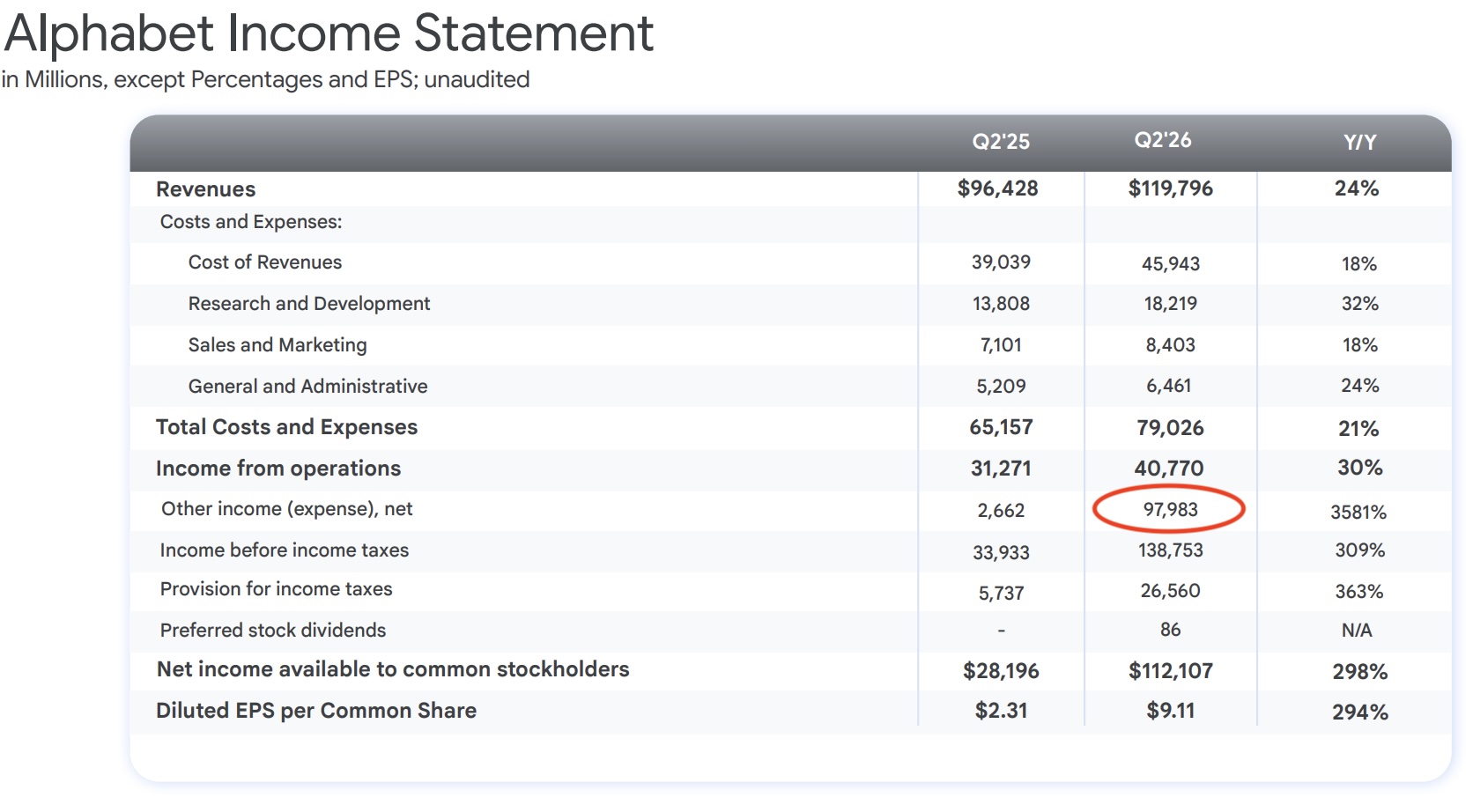
Alphabet (GOOGL, GOOG) is roughly a 7% owner of SpaceX, thanks to a years-ago venture investment. That would likely be worth $100 billion if SpaceX reaches a $1.5 trillion valuation… but the impact on GOOGL shares would likely be diluted, if only because Alphabet is currently valued at ~$4 trillion.
And in the “super indirect” category, there are also plenty of folks arguing that the IPO of SpaceX will bring yet more interest to the space economy, driving shares higher for firms like RocketLab (RKLB), Intuitive Machines (LUNR), Redwire (RDW), or even the newly public Starfighters Space (FJET), which was heavily teased as a private company during their various crowdsourced equity raises over the past few years (and which I still think is silly and unlikely to still be around a few years from now, personally, though I’m sure plenty of intelligent folks disagree).
Funds that own SpaceX shares
Each of these has likely updated their NAV and percentage estimates for SpaceX valuation to match the widely reported $800 million valuation at which SpaceX changed hands privately in December (so you might see older data that some of those Baron funds had 10% in SpaceX, for example, but with the doubling of the estimated value for SpaceX in December, it’s now roughly 20%) — my numbers are rounded for simplicity, and based on the most recent data I’ve seen:
Mutual Funds (NAV reported once a day, trades only at NAV after market close — Interval funds can only be sold/redeemed at preset times, usually once a month or once a quarter):
Baron Focused Growth Fund (BFGIX and BFGFX) — 19% in SpaceX (and 8% in Tesla).
Baron Partners Fund (BPTRX) — Super concentrated in “Elon stories,” has about 22% in SpaceX and 30% in Tesla
Fidelity Contrafund (FCNTX) — Several Fidelity funds have token positions in SpaceX and some other private companies, but Fidelity Contrafund probably has the most meaningful exposure of the genuinely diversified mutual funds, likely in the range of 2-4% of NAV.
Interval Funds (like mutual funds, but do not offer guaranteed or easy redemption every day — generally allow for a limited percentage of shareholders to redeem each quarter, and there’s a meaningful risk of not being able to withdraw, particularly if the market is weak):
ARK Venture Fund (ARKVX) — 12% in SpaceX (and 7.25% in xAI)
Private Shares Fund (PRIVX) — 8-12% in SpaceX (not specifically disclosed recently)
Exchange Traded Funds (ETFs) (can buy and sell all day, but sometimes trades at a (usually small) discount or premium to fair NAV):
Baron First Principles ETF (RONB) — 19% in SpaceX (plus 13.5% in Tesla and 5% in xAI)
EntrepreneurShares Private-Public Crossover ETF (XOVR) — 10% in SpaceX (otherwise mostly publicly traded growth stocks)
Closed-End Funds (CEFs) (can buy and sell all day, but often trade far from NAV — most CEFs trade at a meaningful discount, but big premiums are also possible):
Destiny Tech100 (DXYZ) — 23% in SpaceX. Only CEF I’m aware of that invests only in private companies, updates NAV monthly, has often traded at an extreme premium to NAV (recently ~150%, has been much higher at times).
The Scottish Mortgage Investment Trust (SMT.L, SMTZF) — 15% in SpaceX, otherwise mostly in public growth stocks. Trades at a discount to NAV.
Baillie Gifford US Growth Trust (USA.L, BLGFF) — 11% in SpaceX, otherwise mostly in public growth stocks. Trades at a discount to NAV.(latter two both managed by Baillie Gifford, and listed in London — both would likely be considered PFICs for US tax purposes, a complicating factor that some investors prefer to avoid.)
Buying direct
Accredited investors can sometimes buy SpaceX shares directly, through either share purchases from insiders/employees or participation in special-purpose vehicles (SPVs) that have collected SpaceX shares.
Being “accredited” generally means you have to stipulate that you have assets of over $1 million (excepting your primary residence), or income above $200,000 for at least two years in a row. (The idea was to limit these to “sophisticated” investors who could afford to lose all their money, given the much higher risk and lack of liquidity in private markets, but the limits were set in 1982, when the average family income in the U.S. was roughly $20,000, about 1/6th what it is today, and the “accredited” criteria were never really adjusted (Dodd-Frank in 2010 excluded the value of you personal residence in the $1 million minimum, but otherwise the impulse has been to open the market up more, not to really restrict access to this kind of investing).
Many platforms have sprung up over the past decade or so to provide a marketplace for insiders (usually employees) and investors to trade private shares — these are generally pretty high-friction transactions with fees, a wide bid/ask spread with limited liquidity, and sometimes minimum transactions (often in the $20-50,000 range for stock purchases, usually less for SPVs), so it’s nowhere near as easy and simple as buying a stock… but neither is it, well, rocket science.
Platforms which have had SPVs or shares of SpaceX listed as available in the past have reportedly included Forge, Hiive, SoFi, UpMarket, Nasdaq Private Market, and EquityZen (if you have other favorites, feel free to suggest them below). I have tinkered with most of those, but never purchased shares on any of those platforms, and don’t have any clear reason to choose one over another… though each has different shares available in different companies at any given time, and even a relatively liquid private company like SpaceX might well not be available on any platform at the time you’re most interested in buying (they won’t usually tell you details about what’s currently available on their respective marketplaces until you register for an account, just to add a bit more friction to the research).
So… if you wish to get yourself some exposure to SpaceX before it goes public, with your investment at least theoretically being made at something close to an effective valuation of $800 billion, those are the primary ways to get that piece of the pie… with your exposure being anywhere from 100% for a direct stock purchase, to something in the 10-20% range if you choose one of the investment funds which has a relatively large ownership stake in Elon Musk’s rocket company.
Sound like the kind of thing you’d like to get involved with? Have a favorite way to get SpaceX exposure? Did I miss one of the SpaceX-connected funds or companies? Let us know with a comment below.
A little disclosure: In addition to owning shares of Alphabet and NVIDIA, which I mentioned above, I do own some shares of the Private Shares Fund, personally, though that’s largely because I made a very small investment a decade ago, when it had assets under management of only about $15 million — it has gone up a little in value, and attracted some more investors along the way (AUM is now about $1 billion), but the fund has trailed the market quite dramatically since 2015, with a high expense ratio, and I wouldn’t recommend it, personally. I would likely have sold my PRIVX shares by now if it weren’t a tiny position that’s inconvenient to sell (it’s an interval fund, you get paperwork once a quarter letting you know that you can request redemption, and I haven’t bothered because it’s not meaningful, at roughly 0.1% of my portfolio… there are some ways in which I’m too lazy for this world, so the PRIVX shares still linger).
And as usual, I will not trade in any investment mentioned above for at least three days after publication, per Stock Gumshoe’s trading rules.
Irregulars Quick Take
Paid members get a quick summary of the stocks teased and our thoughts here.
Join as a Stock Gumshoe Irregular today (already a member? Log in)