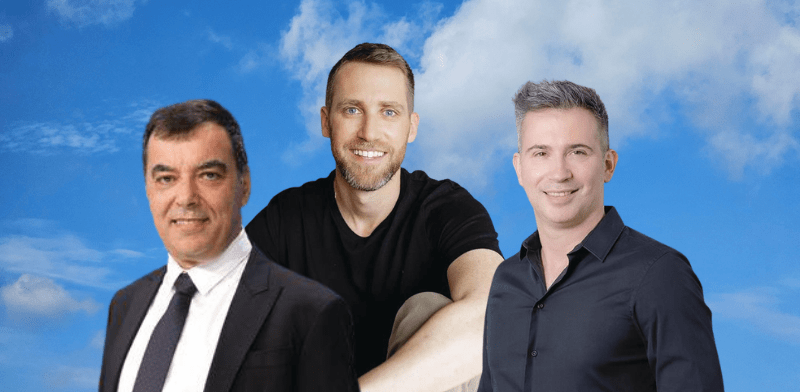
An extraordinary wave of exits has washed over Israel’s technology industry. The deals amount to tens of billions of dollars. In the latest of them, Amnon Shashua’s Mentee Robotics was sold to Mobileye, controlled by Intel, for $900 million. Cloud security company Wiz was sold to Google for $32 billion, in the biggest exit in Israel’s history, and CyberArk was bought by Palo Alto Networks, putting it in second place.
It doesn’t end there. In the past few months it has been reported that cybersecurity company Armis has been bought in a deal that will be worth over $8 billion, in the fourth biggest exit ever. And this week it was reported that marketing analytics company AppsFlyer was in talks on a sale for $1.8-2.1 billion. From conversations with investors and senior players in the industry it appears that many more deals will be reported soon.
The cumulative amount of money flowing to Israel in these deals make the exits a story that belongs not just to the tech industry but one to the entire economy, from the shekel-dollar exchange rate, to state revenues, to a host of workers who have become millionaires. Governor of the Bank of Israel Amir Yaron mentioned the recovery of the local tech industry this week as one of the indicators that enabled the bank’s Monetary Committee to lower the interest rate. “Capital raised by the technology sector in the fourth quarter of last year continued at a high level,” he remarked. According to Bank of Israel figures, technology companies raised NIS 5.8 billion in the fourth quarter, which compares with NIS 5.5 billion in the third quarter and NIS 3 billion in the fourth quarter of 2024.
How much will flow to the state?
Deals in the tens of billions of dollars should on the face of it result in high tax revenue, just when the fiscal deficit is high and defense spending is weighing on the country’s finances. When the structure of the exits is examined more closely, however, it emerges that the picture is more complicated. Dr. Ayal Shenhav, chairperson of law firm Goldfarb Gross Seligman and head of its International and Hi-Tech Department, says that in most exits there is no sale of assets but a sale of shares, which means that tax is not assessed at the company level but at the shareholder level.
“There are three main groups of sellers,” he says. “founders, employees, and investors, and different tax rates apply to each.” While the founders, if they are residents of Israel, generally pay tax of 30-35%, and the employees pay 25-30%, most of the investors, as foreign residents, actually enjoy an exemption from tax. As a result, the state’s revenue from the exits mainly comes from the founders and employees, and not from the investors, unless it’s a case of Israeli investors.
RELATED ARTICLES
Fireblocks buys Israeli startup TRES Finance for $130m
Mobileye buys Shashuas Mentee Robotics for $900m
Israel’s biggest ever exit: Google buying Wiz for $32b
ServiceNow buys Israeli cybersecurity co Armis for $7.75b
A simple way of appreciating the scale, Shenhav suggests, is to take an exit of $100 million. If we assume that the founders own 20-40% of the company and the employees 10-15%, the tax collected from them can be estimated. The share of the foreign investors, which is sometimes a large majority of the company, is hardly taxed at all. “This is a strategic choice by the state, intended to encourage foreign investment, but it means that the direct fiscal contribution is limited,” he explains.
Adv. Inge Aizenberg of Aizenberg, Shinar & Co. adds that the portion that is taxed does not go to the state all at once. “The value of the exit that appears in the headlines represents the overall price of the deal, but the state sees money only at certain stages, mainly when shares and options are actually sold, through capital gains tax and marginal income tax rates, and indirectly through taxation of consumption and investments that come later,” she says. At the time when the deal is signed, in allocations of shares or in share swap delas, there is sometimes no immediate tax event.
This is a revenue stream that is gradual, partial, and sometimes uncertain, she says. “A substantial proportion of the money is attributable to foreign-held shares, to international funds or to legal structures that are not liable to tax in Israel. In the case of the founders and employees too, the value on paper is reduced by the spreading out of payments, tax benefits, and mechanisms set up in the past. In practice, only a relative proportion of the exit translates into tax revenue, and that is sometimes with a delay of months or even years.”
Type of company affects taxation
The type of company sold has an effect on the tax contribution. In deals involving privately-held companies, it is fairly simple to estimate the share of the Israeli founders and employees. When it comes to public companies, however, the picture is much more complicated.
“In a public company, it’s hard to know the proportion held by Israelis and that held by foreign investors,” says Shenhav, referring particularly to the CyberArk acquisition. “There are compensation mechanisms such as options and RSU (restricted stock units), the shareholders change all the time, and there is a large number of them, and so the tax calculation becomes much less transparent.”
Aizenberg asks whether the taxation policy encourages quick sales of companies rather than letting them grow. “When a sale results in higher taxation certainty than continued growth, the economic result is clear,” she says, and calls for a “smart tax policy” that will encourage companies to remain independent and grow, rather than seeking “a momentary big headline.”
Impact on the shekel
The effect is much more noticeable in the foreign exchange market. Modi Shafrir, chief financial markets strategist at Bank Hapoalim, says that not all the money arising from exits is converted to shekels, but that a significant proportion presumably is. “The money due to the employees and the founders is probably mostly converted to shekels, even if it is received in dollars,” he says.
“When more foreign capital comes in than capital that goes out, that is one of the factors that causes the shekel to appreciate.” Shafrir stresses that the exits are not the only factor affecting the exchange rate, but “in the general balance, more money comes into Israel than goes out, which tends to make the shekel stronger.”
The shekel has recently reached a four-year peak against the US dollar. In Shafrir’s view, this trend will continue in the coming year, assuming that there is no unusual geopolitical event. “Since late 2024, we have seen the shekel strengthen substantially. It may be that the trend is mostly behind us, but as long as global markets are stable and the inflow of capital continues, the shekel will remain strong.”
At the same time, he says, a strong shekel can become a two-edged sword. On the one hand, it’s a deflationary force that restrains price rises and enables the Bank of Israel to lower interest rates. On the other hand, it hurts exporting industries, particularly low-tech exports and companies that don’t do currency hedging. “For companies with low profit margins, this kind of currency appreciation can become a real problem,” he says.
Along with this, Shafrir points to a secondary effect: a growing sense of wealth. “The flow of money supports local consumption and strengthens the capital market. This is a process that supports the economy.” At this stage, he says, the money is still not flowing in large amounts to the real estate market, but the assessment is that some of it is likely to go that way later on.
What has happened to the big flotations?
Meanwhile, the obvious question is why do so many companies choose to be acquired instead of continuing to grow to the point at which they can make an IPO? Raz Mangel, a partner at venture capital firm Greenfield Partners, suggests seeing the wave of exits as a result of business maturity and not as weakness. “The choice between a flotation and an exit is not a binary one,” he says. “There are companies that could be floated, but when they reach a significant scale and receive an offer that makes it possible to accelerate their business within a large global enterprise, that’s a decision against which waiting is hard to justify. Not every company is built to go public, and that’s not a failure.”
Mangel says that the big exits of recent years are not like the wave of small acquisitions that characterized the cybersecurity sector in the past. “These are not sales of young companies, but of companies that have reached impressive maturity, and global players want to take their technologies and turn them into part of their core strategies. When there’s a price that reflects both the risk and the macro conditions, it’s a price that’s hard to say no to.”
Mangel stresses that the question whether a company was sold too soon is one that is almost impossible to decide with hindsight. “To be a public company you have to reach a very large scale, and everything has to align, the market, the strategy, and the timing. Many companies were simply not meant to be public, and that’s not a bad thing. The risk always exists, and the founders have to live with it.”
Mangel also points to a cumulative effect that doesn’t make the headlines: the know-how and experience that flow back to the market. “Founders and employees who become part of global companies learn how to run a business on an American scale. Many of them subsequently return to the Israeli market as serial entrepreneurs, with experience, contacts, and very large ambitions. In that sense, the exit is not the end of the road, but just a stage in the cycle.”
Published by Globes, Israel business news – en.globes.co.il – on January 8, 2026.
© Copyright of Globes Publisher Itonut (1983) Ltd., 2026.






-1024x683.jpg "Judge Who Helped Violent Illegal Alien Evade ICE Faces New Test")


-1024x683.jpg "Montana Puts Democrats in a Bind as Senate Hopes Fade")