No Result
View All Result
SUBMIT YOUR ARTICLES
  • Login
Sunday, February 22, 2026
TheAdviserMagazine.com
  • Home
  • Financial Planning
    • Financial Planning
    • Personal Finance
  • Market Research
    • Business
    • Investing
    • Money
    • Economy
    • Markets
    • Stocks
    • Trading
  • 401k Plans
  • College
  • IRS & Taxes
  • Estate Plans
  • Social Security
  • Medicare
  • Legal
  • Home
  • Financial Planning
    • Financial Planning
    • Personal Finance
  • Market Research
    • Business
    • Investing
    • Money
    • Economy
    • Markets
    • Stocks
    • Trading
  • 401k Plans
  • College
  • IRS & Taxes
  • Estate Plans
  • Social Security
  • Medicare
  • Legal
No Result
View All Result
TheAdviserMagazine.com
No Result
View All Result
Home Market Research Economy

The Fast Fashion Dilemma – Econlib

by TheAdviserMagazine
2 months ago
in Economy
Reading Time: 4 mins read
A A
The Fast Fashion Dilemma – Econlib
Share on FacebookShare on TwitterShare on LInkedIn


Shoppers are filling their carts, both literally and digitally, with last-minute gifts. One tempting purchase, whether for gifting or for showing up in style at a holiday sweater party, is ultra-cheap clothing from Shein. Like many around the world, the French hunt for deals in December.

During a recent interview with journalist Thomas Mahler, I learned that fast fashion has become a political flashpoint in France, the country known for haute couture. French lawmakers are considering measures aimed at threatening the economic viability of Shein, the Chinese company that dominates ultra-cheap clothing globally. 

Millions of French consumers shop through Shein regularly. Mahler asked me: Can politicians persuade consumers to buy domestically-made clothes instead, in a country with a proud tradition in domestic fashion? My reply was that this dilemma extends beyond France. Wealthy countries do not manufacture much apparel at home. It’s cheaper to produce at scale in lower-income countries, and residents of rich nations rarely aspire to work in garment factories. 

The French government’s proposed intervention is an “eco-penalty” on fast-fashion items, a tax that could eventually add €10 per garment. The purpose is to make French-made clothing more competitive while also discouraging the environmental excesses of disposable fashion.

Fast fashion generates garbage. Trend cycles in cheap apparel last for only weeks instead of seasons. Shein adds many new items daily, while a traditional French fashion house releases only a few designs each year. Much of the clothing is so cheaply made that it’s worn only a few times before being thrown away. Even charities struggle to accept donated garments because of the flood of unwanted clothes. Discarded polyester shirts pile up in landfills at best, or pollute rivers and beaches at worst. Synthetic fibers shed microplastics. These are real externalities. 

France’s approach thus combines modern environmentalism with a familiar protectionism. It may be politically easier to sell a tariff when it’s framed as discouraging “wasteful” consumption rather than only protecting domestic producers.

Revealed preferences, meaning the preferences people demonstrate through their actual purchasing behavior rather than their stated ideals, show that consumers want affordability and variety. That puts them at odds with protectionist policymakers. When a Shein dress costs €15 and a French-made equivalent costs €100, even patriotic consumers face a hard trade-off. The price gap reflects not just labor costs, but supply-chain efficiencies, economies of scale, and a fundamentally different business model.

Even if these measures succeeded in reducing the amount of clothing bought from Shien, would the French people take garment manufacturing jobs that are “brought back” to France? French youth unemployment hovers above 17%, but garment work doesn’t match the aspirations of an educated workforce. In the United States, the few apparel factories that remain largely employ recent immigrants. Is trying to rebuild a mid-20th-century industrial base like trying to resurrect typewriters? Nostalgia is not an economic strategy in a technologically advancing world. Furthermore, would robots soon “take” most jobs that could be done by French people today in garment manufacturing? 

Mahler also asked me whether people could simply buy fewer clothes to help the environment. It’s an interesting question because we also see this dilemma with food in the rich world today. Calories were once expensive; now the binding constraint is waistlines, not income. Clothing has followed the same pattern. After the Multi-Fiber Arrangement ended in 2005, global textile trade boomed. For example, one Chinese city now produces more than 20 billion pairs of socks per year, which they can export at low prices. For many consumers, the price of clothes is not the main constraint on how many garments they purchase. The result has been the democratization of style and abundance.

Reasonable people can debate the appropriate policy response. A Pigouvian tax on new garments to fund recycling or reduce waste, akin to a carbon tax, is worth considering. Better labeling, such as durability ratings, could help consumers make more informed decisions on how long garments will last so they can appropriately trade off price versus quality. Cultural norms are shifting such that some consumers brag about thrift-store finds rather than new purchases, somewhat reducing the flow of new clothes to landfills. 

While addressing the excesses of cheap fashion, we should resist romanticizing the past. We should not return to a world in which only the rich could afford variety and comfort. Countries like Bangladesh and Vietnam have reduced poverty by joining global garment supply chains. Bangladesh’s GDP per capita was under $500 in 1998; today it is over $2,500. 

Fast fashion is neither a triumph nor a catastrophe. It is the outcome of solving an important problem: how to clothe billions of people affordably. The French, along with many of us around the world, now face a more pleasant question: how much is enough once basic scarcity has been conquered?

Someone from 1850, wearing his one patched coat, would be astonished to learn that we are debating whether people buy too many clothes. That we have the luxury to ask is evidence that, despite its problems, the system has delivered something extraordinary.



Source link

Tags: DilemmaEconlibFashionFast
ShareTweetShare
Previous Post

Intuit CEO says Gen Z is staving off recession by putting it on plastic

Next Post

Tesla: Bullenfalle oder perfekte Einstiegschance?

Related Posts

edit post
Chuck Schumer Has Trump Derangement Syndrome

Chuck Schumer Has Trump Derangement Syndrome

by TheAdviserMagazine
February 22, 2026
0

  At this point, the Democrats have taken the absurd position to block ID to vote insulting the minorities as...

edit post
Has China Blown The US Out Of The Sky?

Has China Blown The US Out Of The Sky?

by TheAdviserMagazine
February 22, 2026
0

 The J-36 is reported to operate effectively above 65,000 feet (20,000 meters), giving it a literal “high ground” over the...

edit post
Supreme Court’s Trump tariff decision: five takeaways

Supreme Court’s Trump tariff decision: five takeaways

by TheAdviserMagazine
February 21, 2026
0

U.S. President Donald Trump gestures as he speaks during a press briefing at the White House, following the Supreme Court's...

edit post
Four-Letter Economic Words | Mises Institute

Four-Letter Economic Words | Mises Institute

by TheAdviserMagazine
February 21, 2026
0

In this episode, Mark Thornton offers a practical “seven-word” framework for navigating economic life, especially when policy chaos and uncertainty...

edit post
Market Talk – February 20, 2026

Market Talk – February 20, 2026

by TheAdviserMagazine
February 20, 2026
0

    ASIA: The major Asian stock markets had a mixed day today: • NIKKEI 225 decreased 642.13 points or...

edit post
Trump’s Tariffs & The New Risk Ahead

Trump’s Tariffs & The New Risk Ahead

by TheAdviserMagazine
February 20, 2026
0

Over 60% of total tariff revenue in 2025 stemmed from tariffs imposed under IEEPA, which has never before been used...

Next Post
edit post
Tesla: Bullenfalle oder perfekte Einstiegschance?

Tesla: Bullenfalle oder perfekte Einstiegschance?

edit post
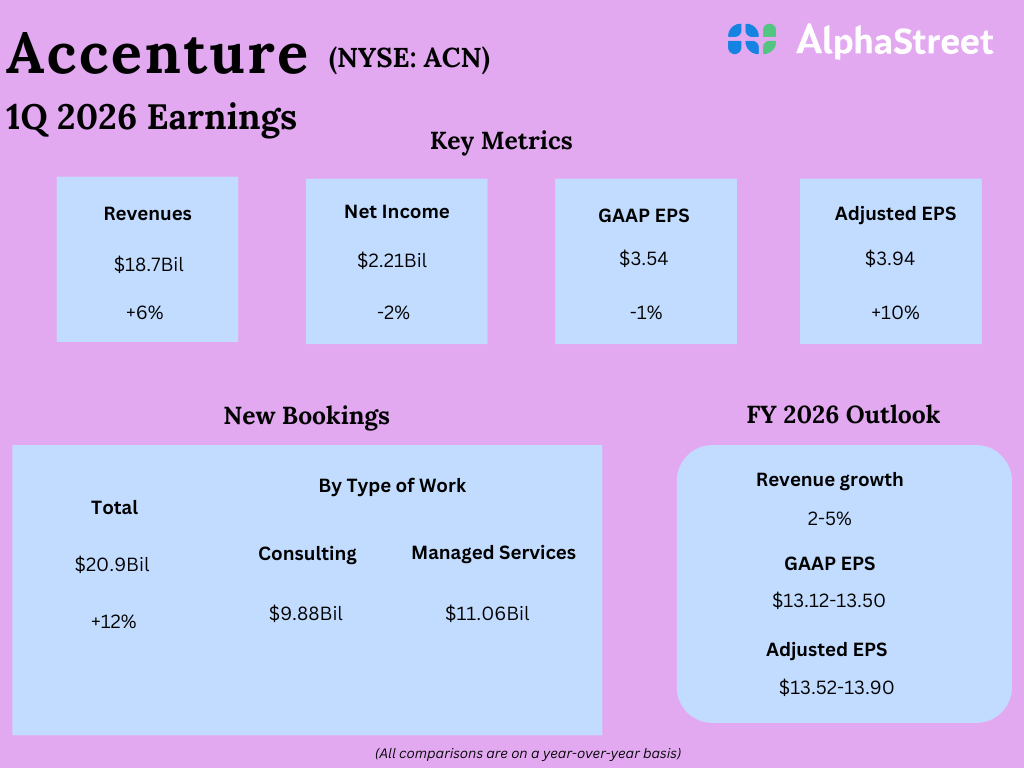
ACN Earnings: Key quarterly highlights from Accenture’s Q1 2026 financial results

ACN Earnings: Key quarterly highlights from Accenture’s Q1 2026 financial results

  • Trending
  • Comments
  • Latest
edit post
Medicare Fraud In California – 2.5% Of The Population Accounts For 18% Of NATIONWIDE Healthcare Spending

Medicare Fraud In California – 2.5% Of The Population Accounts For 18% Of NATIONWIDE Healthcare Spending

February 3, 2026
edit post
North Carolina Updates How Wills Can Be Stored

North Carolina Updates How Wills Can Be Stored

February 10, 2026
edit post
Gasoline-starved California is turning to fuel from the Bahamas

Gasoline-starved California is turning to fuel from the Bahamas

February 15, 2026
edit post
Where Is My 2025 Oregon State Tax Refund

Where Is My 2025 Oregon State Tax Refund

February 13, 2026
edit post
2025 Delaware State Tax Refund – DE Tax Brackets

2025 Delaware State Tax Refund – DE Tax Brackets

February 16, 2026
edit post
Key Nevada legislator says lawmakers will push for independent audit of altered public record in Nevada OSHA’s Boring Company inspection 

Key Nevada legislator says lawmakers will push for independent audit of altered public record in Nevada OSHA’s Boring Company inspection 

February 4, 2026
edit post
Is CrowdStrike Stock a Buy After Falling 17% Year to Date?

Is CrowdStrike Stock a Buy After Falling 17% Year to Date?

0
edit post
Week 8: A Peek Into This Past Week + What I’m Reading, Listening to, and Watching!

Week 8: A Peek Into This Past Week + What I’m Reading, Listening to, and Watching!

0
edit post
Trump Orders Temporary 10% Global Tariff to Replace Duties Struck Down by US Supreme Court

Trump Orders Temporary 10% Global Tariff to Replace Duties Struck Down by US Supreme Court

0
edit post
10 quiet things people stop doing in their 60s that their family barely notices — but each one is a small surrender of the life they imagined and by the time anyone realizes what happened the person they used to be has already left the room

10 quiet things people stop doing in their 60s that their family barely notices — but each one is a small surrender of the life they imagined and by the time anyone realizes what happened the person they used to be has already left the room

0
edit post
1 Stock to Buy, 1 Stock to Sell This Week: Nvidia, Intuit

1 Stock to Buy, 1 Stock to Sell This Week: Nvidia, Intuit

0
edit post
What Documents Do I Need to File My Taxes? 

What Documents Do I Need to File My Taxes? 

0
edit post
Is CrowdStrike Stock a Buy After Falling 17% Year to Date?

Is CrowdStrike Stock a Buy After Falling 17% Year to Date?

February 22, 2026
edit post
9 Utility Discount Programs Seniors Lose Automatically If They Don’t Re-Enroll

9 Utility Discount Programs Seniors Lose Automatically If They Don’t Re-Enroll

February 22, 2026
edit post
Will Coinbase Crash or Rally in Feb 2026?

Will Coinbase Crash or Rally in Feb 2026?

February 22, 2026
edit post
10 quiet things people stop doing in their 60s that their family barely notices — but each one is a small surrender of the life they imagined and by the time anyone realizes what happened the person they used to be has already left the room

10 quiet things people stop doing in their 60s that their family barely notices — but each one is a small surrender of the life they imagined and by the time anyone realizes what happened the person they used to be has already left the room

February 22, 2026
edit post
Week 8: A Peek Into This Past Week + What I’m Reading, Listening to, and Watching!

Week 8: A Peek Into This Past Week + What I’m Reading, Listening to, and Watching!

February 22, 2026
edit post
Bitcoin bulls could walk into a  billion liquidation trap as Bank of America warns multiples are about to compress

Bitcoin bulls could walk into a $1 billion liquidation trap as Bank of America warns multiples are about to compress

February 22, 2026
The Adviser Magazine

The first and only national digital and print magazine that connects individuals, families, and businesses to Fee-Only financial advisers, accountants, attorneys and college guidance counselors.

CATEGORIES

  • 401k Plans
  • Business
  • College
  • Cryptocurrency
  • Economy
  • Estate Plans
  • Financial Planning
  • Investing
  • IRS & Taxes
  • Legal
  • Market Analysis
  • Markets
  • Medicare
  • Money
  • Personal Finance
  • Social Security
  • Startups
  • Stock Market
  • Trading

LATEST UPDATES

  • Is CrowdStrike Stock a Buy After Falling 17% Year to Date?
  • 9 Utility Discount Programs Seniors Lose Automatically If They Don’t Re-Enroll
  • Will Coinbase Crash or Rally in Feb 2026?
  • Our Great Privacy Policy
  • Terms of Use, Legal Notices & Disclosures
  • Contact us
  • About Us

© Copyright 2024 All Rights Reserved
See articles for original source and related links to external sites.

Welcome Back!

Login to your account below

Forgotten Password?

Retrieve your password

Please enter your username or email address to reset your password.

Log In
No Result
View All Result
  • Home
  • Financial Planning
    • Financial Planning
    • Personal Finance
  • Market Research
    • Business
    • Investing
    • Money
    • Economy
    • Markets
    • Stocks
    • Trading
  • 401k Plans
  • College
  • IRS & Taxes
  • Estate Plans
  • Social Security
  • Medicare
  • Legal

© Copyright 2024 All Rights Reserved
See articles for original source and related links to external sites.