“Tax Fairness” is commonly used in European policy circles to justify higher taxes. Despite being subjective, the meaning of “taxA tax is a mandatory payment or charge collected by local, state, and national governments from individuals or businesses to cover the costs of general government services, goods, and activities. fairness” has expanded from being shorthand for combating tax fraud and avoidance to promoting a certain vision of redistributive tax policy. The call for higher taxes is often justified by the need for more public goods, such as hospitals, schools, and roads; however, these are precisely the in-kind benefits that are ignored when defining tax fairness to begin with.
A welfare state is a system in which the government plays a central role in securing citizens’ economic and social well-being through programs such as public health care, education, pensions, unemployment insurance, and various social transfers. But who really pays for European welfare states? Many assume the answer is obvious: high-income earners contribute while low-income earners benefit. However, that assumption is only partly true, and often misleading.
In a new, comprehensive assessment of net fiscal contributions in the EU,[1] my coauthor Monika Köppl-Turyna and I provide a more realistic view of the fiscal relationship between European households and the state. Our study reveals that when indirect taxes (such as value-added tax, or VAT) and in-kind benefits (such as health care and education) are included alongside direct taxes and cash transfers, the number of households classified as net contributors to public finances significantly declines.
This more holistic picture should shift policymakers’ focus from tax fairness to fiscal fairness. Fiscal fairness is a framework for evaluating economic fairness that considers both sides of the fiscal equation, taxes paid and contributions made through jobs, investment, and growth. It recognizes that social value arises not only from redistribution but also from economic activity.
Measuring the Full Fiscal Footprint
Traditional public finance analysis typically measures redistribution by comparing pre-tax and post-tax incomes. This approach focuses on direct taxes, like income or social security contributions, and transfers, such as unemployment or child benefits. But this approach misses two critical features of modern welfare states.
First, it omits indirect taxes, which are paid every time a household consumes. These taxes make up a significant share of public revenues across the EU countries (32.4 percent in 2023 according to EUROSTAT). Second, it overlooks in-kind benefits. These services are essential to households’ well-being and represent a substantial form of government support.
By measuring how much households pay in taxes (directly and indirectly), and how much households receive in benefits (both cash and in-kind), we construct a net fiscal incidence measure that more accurately reflects the overall impact of government policy across income groups. Our results challenge conventional wisdom and help explain why perceptions of tax fairness often don’t align with fiscal reality.
Who Are the Net Contributors?
One of the clearest insights from the research is that richer households are substantially more likely to be net contributors to the public purse. Meanwhile, households in the lower and middle parts of the income distribution, including those often described as the “squeezed middle,” are more likely to be net beneficiaries once in-kind benefits are fully accounted for. While they contribute significantly through income tax and VAT, the value of in-kind benefits received often exceeds their total tax burden by far. In general, as highlighted in the graph below, the number of net contributors drops substantially in all EU countries when in-kind benefits and indirect taxes are accounted for.
This is an important feature of the welfare state model. Redistribution in Europe takes place not only through cash transfers, but also through universal access to public services. These services, though less visible than monthly benefit payments, form the backbone of social support in most EU countries.
In-Kind Benefits and VAT Are the Hidden Redistributors
In-kind benefits are one of the largest drivers of redistribution in most countries. Universal access to health care and education generates substantial benefits, particularly for lower-income households, while being financed collectively, primarily through broad-based taxes like income taxes and VAT.
Indirect taxes like VAT are often criticized as regressive because lower-income households tend to spend a larger share of their income on consumption. However, in a recent study of European countries,[2] we show that this regressive effect is limited and, crucially, more than offset by the progressive impact of in-kind benefits.
Across the EU, income inequality (in disposable income) varies widely when measured by the Gini index. Before accounting for in-kind benefits and VAT, inequality ranges widely. When public services and indirect taxes are factored in, Gini values drop noticeably across all countries, by roughly 3 to 6 points on average, showing the equalizing impact of government transfers and social benefits. The smallest gaps between disposable income and post-transfer measures appear in more redistributive systems, such as Belgium, Finland, and Austria. The largest gaps occur in Bulgaria, Latvia, and Luxembourg, where inequality remains comparatively high even after transfers.
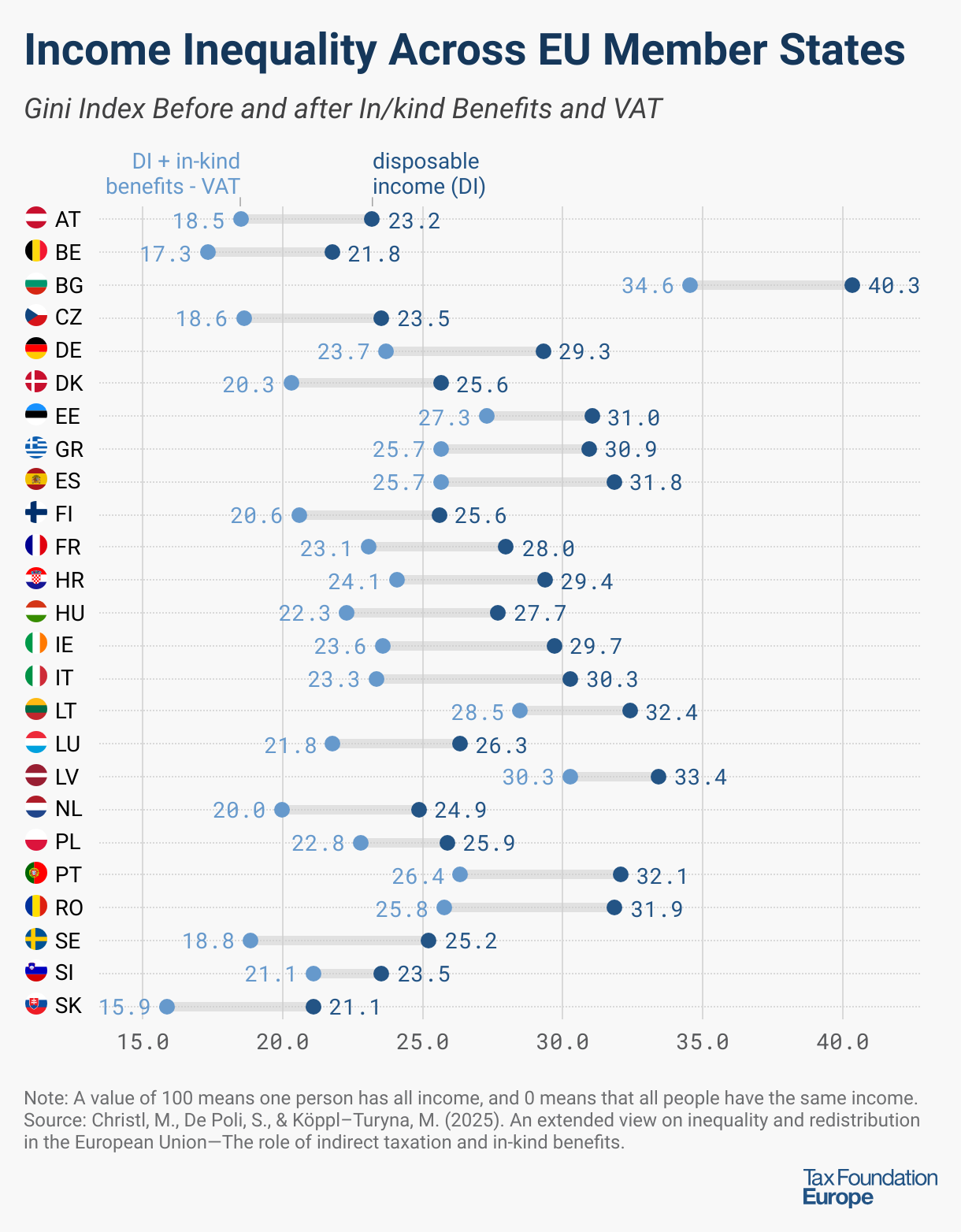
In short, VAT may slightly raise inequality by itself, but when paired with universal public services, it becomes part of a strongly redistributive system. This shows that, despite the common framing, tax efficiency is not necessarily antithetical to a government’s given social goals. A tax system that relies on neutral, broad-based instruments like VAT can still achieve fiscal fairness if the spending side is well-designed and targeted.
Trust, Perception, and Policy
As discussed in a recent interview series, public perception of who pays and who benefits often shapes political debate more than the facts. But, in reality, many households are net beneficiaries of the welfare states once all elements—cash benefits, services, and taxes—are included.
Such misperceptions undermine public trust and reduce political support for reforms that could improve efficiency, sustainability, or transparency. A narrow focus on income tax rates alone can lead to distorted conclusions and poor policy. Fiscal fairness is a better framework for analyzing policy design.
Rethinking Fairness and Sustainability
This broader understanding also highlights a long-term challenge. If the vast majority of the population are net beneficiaries over their lifetimes, then the fiscal system depends disproportionately on the contributions of a small share of high-income earners. This places real limits on how far redistribution can go without risking disincentives, capital flight, or a narrowing tax baseThe tax base is the total amount of income, property, assets, consumption, transactions, or other economic activity subject to taxation by a tax authority. A narrow tax base is non-neutral and inefficient. A broad tax base reduces tax administration costs and allows more revenue to be raised at lower rates..
Sustainable redistribution requires a system that is not only fair, but also efficient and growth-friendly. And these objectives are compatible, but only if tax and spending policies are based on facts, not assumptions.
The debate over who funds the welfare states should not rest on rhetoric or partial data. Redistribution is more extensive, and more complex, than commonly perceived. It is driven not just by progressive income taxation, but by the combination of neutral taxes and universally accessible public services. Understanding this is key to designing tax systems that are not only sustainable and pro-growth, but also perceived as legitimate by those who finance and rely on them.
Stay informed on the tax policies impacting you.
Subscribe to get insights from our trusted experts delivered straight to your inbox.
Subscribe
References
[1] Michael Christl and Monika Köppl‐Turyna, “Net Fiscal Contributions in the EU—The Role of Indirect Taxation and In‐Kind Benefits,” Kyklos 78:4 (2025): 1607-1636.
[2] Michael Christl, Silvia De Poli, and Monika Köppl–Turyna, “An extended view on inequality and redistribution in the European Union—The role of indirect taxation and in-kind benefits,” Economic Analysis and Policy (2025).
Share this article