No Result
View All Result
SUBMIT YOUR ARTICLES
  • Login
Wednesday, March 25, 2026
TheAdviserMagazine.com
  • Home
  • Financial Planning
    • Financial Planning
    • Personal Finance
  • Market Research
    • Business
    • Investing
    • Money
    • Economy
    • Markets
    • Stocks
    • Trading
  • 401k Plans
  • College
  • IRS & Taxes
  • Estate Plans
  • Social Security
  • Medicare
  • Legal
  • Home
  • Financial Planning
    • Financial Planning
    • Personal Finance
  • Market Research
    • Business
    • Investing
    • Money
    • Economy
    • Markets
    • Stocks
    • Trading
  • 401k Plans
  • College
  • IRS & Taxes
  • Estate Plans
  • Social Security
  • Medicare
  • Legal
No Result
View All Result
TheAdviserMagazine.com
No Result
View All Result
Home Market Research Market Analysis

What Technical Debt Means To IT Professionals

by TheAdviserMagazine
4 months ago
in Market Analysis
Reading Time: 4 mins read
A A
What Technical Debt Means To IT Professionals
Share on FacebookShare on TwitterShare on LInkedIn


Technical debt continues to rise in the priorities of IT leaders. While AI may be grabbing the front page headlines, tech debt is lurking below the surface in more and more industry conversations. Ironically, for such a hot topic, there’s little consensus on how to even define it.

It’s No Longer Just Code Quality

When Forrester’s 2025 Modern Technology Operations Survey asked 593 IT professionals what technical debt means to them, the results were surprising. Code quality—Ward Cunningham’s original definition and the focus of countless academic papers and LinkedIn commentaries—ranked low with only 27% of respondents selecting it.

This data reveals a fundamental disconnect between how purists and academics define technical debt and how practitioners experience it. While some continue to insist that technical debt refers exclusively to shortcuts taken when writing software, IT practitioners clearly embrace a far broader definition.

It’s unsurprising: the word “technical” carries broad connotations, and thus real world practitioners have naturally extended “technical debt” to encompass all deferred technical work. When your most experienced engineers retire without documenting critical systems, when you’re still critically dependent on Java 8, when your hardware could fail at any moment—these aren’t separate categories of debt that need distinct terminology. They’re all part of the technical debt burden that organizations must actively manage.

Managing the Full Portfolio

These aren’t isolated problems; as I’ve written elsewhere, it’s an integrated system of feedback loops. Sprawling, outdated tech requires outdated skills, creating a vicious cycle of knowledge and migration debt. Inflexible architectures force organizations to build redundant systems rather than adapt existing ones. Everything compounds together in ways that require an integrated view for effective management.

Some argue for separate terminology: infrastructure debt, architecture debt, process debt. But this misses the point. Organizations need an umbrella term for deferred technical work and investment.  Don’t confuse your leaders and business partners with multiple terms and flavors. Keep it simple and you’re more likely to get the resources you need.

The Path Forward

The Forrester data provides clear guidance on where organizations should focus.

Knowledge and process debt, selected by 37% of respondents, demands immediate attention through process improvement, re-engineering, and organizational change management.
Unsupported vendor software and redundant IT systems, each selected by 30-32% of respondents, requires proactive migration planning before crisis points emerge.
System inflexibility, identified by 35%, calls for architectural investments that preserve future options.
And yes, code quality, selected by 27%, deserves attention as part of the portfolio, not as the sole focus.

For academics and purists insisting that the Ward Cunningham definition is a strict scope: it’s time to acknowledge that language evolves based on utility, not theoretical purity, and the horse has left the barn. Fighting this evolution wastes energy that could be spent developing better frameworks for managing the full spectrum of technical obligations.

For practitioners, the message is validating: you’re not wrong to call all of this technical debt. Your daily reality of managing everything from knowledge gaps to hardware failures under a single conceptual umbrella makes operational sense. The interconnected nature of these challenges demands integrated management, not artificial separation.

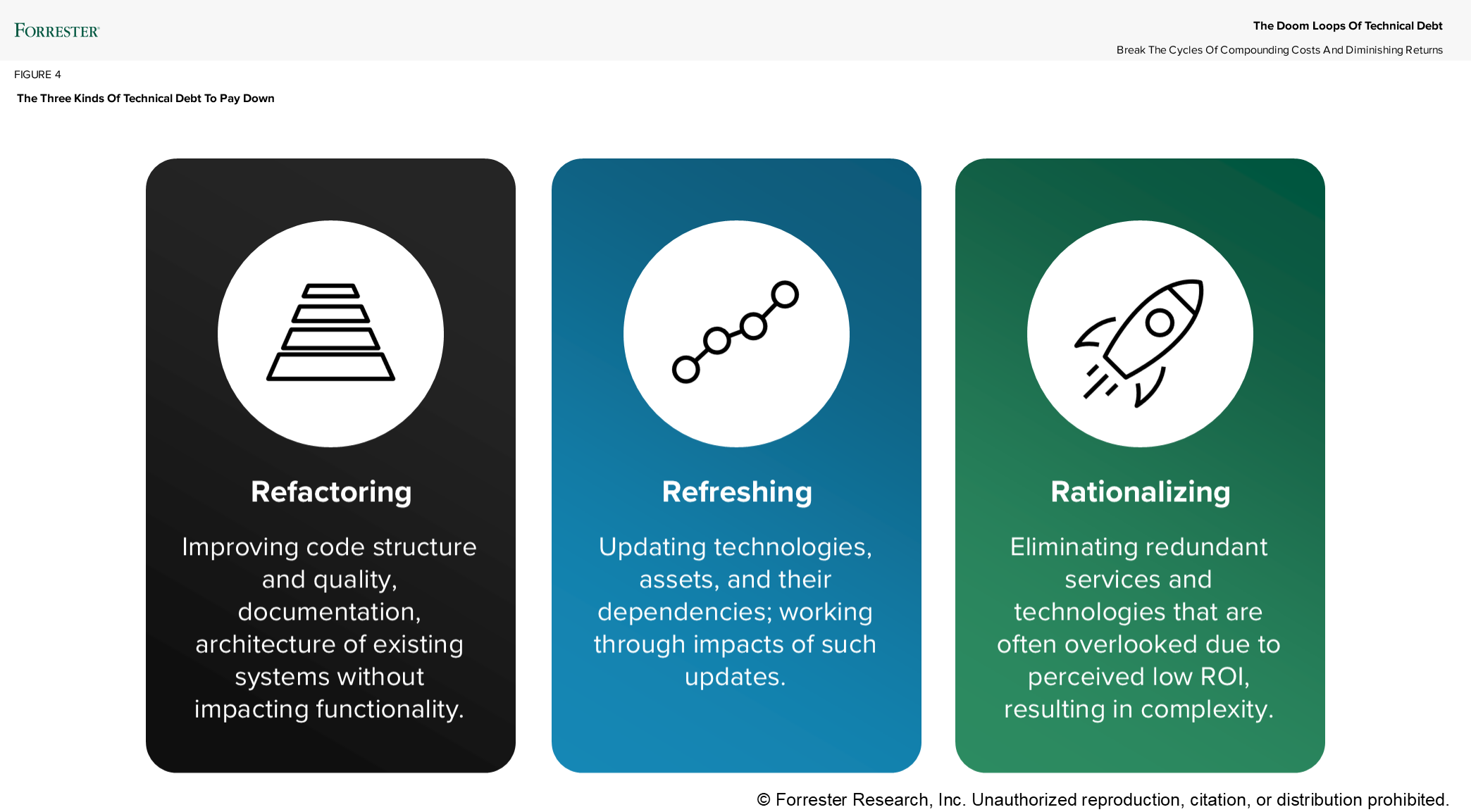
For organizations, the path forward is clear. Stop letting terminology debates distract from the real issue. You have a portfolio of deferred technical investment that requires active management and ongoing investment (emerging best practice is that 20-25% of ongoing spend be devoted to modernization). Some involves code, much doesn’t, all of it compounds over time. The question isn’t what to call these different types of deferred work—practitioners have already decided. The question is how to manage them effectively as the interconnected portfolio of non-optional spending they’ve always represented. We propose three major levers: refactoring, rationalization, and refreshing.

Practitioners know exactly what their technical debt encompasses in their complex digital operations. The most successful organizations will be those that embrace this broader understanding and develop portfolio management strategies that address technical debt in all its forms — from the knowledge walking out the door, to systems that can’t adapt, to sprawl and obsolescence, to the code that yes, could be cleaner.

In an era where IT underpins every aspect of business success, managing technical debt as a comprehensive portfolio isn’t just good practice. It’s essential for survival. The 593 professionals surveyed by Forrester aren’t confused about terminology. They’re dealing with reality. It’s time the purists and academics catch up.

Let’s continue the conversation:  request a guidance session.



Source link

Tags: debtmeansprofessionalstechnical
ShareTweetShare
Previous Post

Cisco (CSCO) reports higher Q1 revenue and earnings; results beat estimates

Next Post

How advisors are responding to falling client risk tolerance

Related Posts

edit post
The Definitive Guide to Eliminating Channel Conflict

The Definitive Guide to Eliminating Channel Conflict

by TheAdviserMagazine
March 24, 2026
0

The manual spreadsheet remains the single greatest threat to your indirect sales revenue as we approach 2026. When a direct...

edit post
The Air Traffic Control Tower Your CS Team Needs

The Air Traffic Control Tower Your CS Team Needs

by TheAdviserMagazine
March 24, 2026
0

Customer success managers (CSMs) are like pilots. They know how to fly the plane and keep customers moving toward their...

edit post
4 Stocks Offering Reliable Income and Buybacks Amid Market Uncertainty

4 Stocks Offering Reliable Income and Buybacks Amid Market Uncertainty

by TheAdviserMagazine
March 24, 2026
0

High shareholder yield backed by strong cash flow and disciplined capital allocation. Buybacks and dividends are funded sustainably without relying...

edit post
7 Mintel Predictions Realized in Food & Health

7 Mintel Predictions Realized in Food & Health

by TheAdviserMagazine
March 23, 2026
0

Expo West 2026 offered a clear reflection of several long-running shifts Mintel has been tracking across health, nutrition, and consumer...

edit post
A Product Leader’s Roadmap To B2B Summit North America

A Product Leader’s Roadmap To B2B Summit North America

by TheAdviserMagazine
March 23, 2026
0

There’s a growing gap between how products are built and how they’re bought. Buyers rely more on AI, engage later...

edit post
Channel Sales Software

Channel Sales Software

by TheAdviserMagazine
March 23, 2026
0

Computer Market Research (CMR): The Ultimate Channel Management Compendium PART 1 Table of Contents for Part 1 Introduction to Channel...

Next Post
edit post
How advisors are responding to falling client risk tolerance

How advisors are responding to falling client risk tolerance

edit post
How OBBBA changes the educators tax deduction in 2026

How OBBBA changes the educators tax deduction in 2026

  • Trending
  • Comments
  • Latest
edit post
Foreclosure Starts are Up 19%—These Counties are Seeing the Highest Distress

Foreclosure Starts are Up 19%—These Counties are Seeing the Highest Distress

February 24, 2026
edit post
Publix to Open 5 New Stores by End of April. See Upcoming Locations.

Publix to Open 5 New Stores by End of April. See Upcoming Locations.

March 20, 2026
edit post
7 States Reporting a Surge in Norovirus Cases

7 States Reporting a Surge in Norovirus Cases

February 22, 2026
edit post
Massachusetts loses billions in income after millionaire tax

Massachusetts loses billions in income after millionaire tax

March 24, 2026
edit post
The Growing Movement to End Property Taxes Continues in Kentucky, And What It Means For Investors

The Growing Movement to End Property Taxes Continues in Kentucky, And What It Means For Investors

March 2, 2026
edit post
Who Is Legally Next of Kin in North Carolina?

Who Is Legally Next of Kin in North Carolina?

February 28, 2026
edit post
General Mills – GIS:  Outside Reversal beim Lebensmittelhersteller!

General Mills – GIS: Outside Reversal beim Lebensmittelhersteller!

0
edit post
Attractive valuations emerging, but oil prices hold the key: Aman Chowhan

Attractive valuations emerging, but oil prices hold the key: Aman Chowhan

0
edit post
Bitcoin faces a new threat after US PMI reignites stagflation fears

Bitcoin faces a new threat after US PMI reignites stagflation fears

0
edit post
Rothbard on Interventionism: Writing the Last Chapter of Economic Theory

Rothbard on Interventionism: Writing the Last Chapter of Economic Theory

0
edit post
Iran claims U.S. is negotiating with itself; here’s what Tehran is demanding

Iran claims U.S. is negotiating with itself; here’s what Tehran is demanding

0
edit post
Quiz: What’s Your “Tax Vibe”?

Quiz: What’s Your “Tax Vibe”?

0
edit post
Attractive valuations emerging, but oil prices hold the key: Aman Chowhan

Attractive valuations emerging, but oil prices hold the key: Aman Chowhan

March 25, 2026
edit post
Iran claims U.S. is negotiating with itself; here’s what Tehran is demanding

Iran claims U.S. is negotiating with itself; here’s what Tehran is demanding

March 25, 2026
edit post
General Mills – GIS:  Outside Reversal beim Lebensmittelhersteller!

General Mills – GIS: Outside Reversal beim Lebensmittelhersteller!

March 25, 2026
edit post
China could be the ‘big winner’ in the AI race, thanks to abundant power, cheap manufacturing, and an open-source craze

China could be the ‘big winner’ in the AI race, thanks to abundant power, cheap manufacturing, and an open-source craze

March 25, 2026
edit post
Mapping The Ocean Floor – The Next War Will Be Fought In Silence

Mapping The Ocean Floor – The Next War Will Be Fought In Silence

March 25, 2026
edit post
Bitcoin, XRP Rallies Won’t Hold Until Oil Falls Toward , Expert Warns

Bitcoin, XRP Rallies Won’t Hold Until Oil Falls Toward $80, Expert Warns

March 24, 2026
The Adviser Magazine

The first and only national digital and print magazine that connects individuals, families, and businesses to Fee-Only financial advisers, accountants, attorneys and college guidance counselors.

CATEGORIES

  • 401k Plans
  • Business
  • College
  • Cryptocurrency
  • Economy
  • Estate Plans
  • Financial Planning
  • Investing
  • IRS & Taxes
  • Legal
  • Market Analysis
  • Markets
  • Medicare
  • Money
  • Personal Finance
  • Social Security
  • Startups
  • Stock Market
  • Trading

LATEST UPDATES

  • Attractive valuations emerging, but oil prices hold the key: Aman Chowhan
  • Iran claims U.S. is negotiating with itself; here’s what Tehran is demanding
  • General Mills – GIS: Outside Reversal beim Lebensmittelhersteller!
  • Our Great Privacy Policy
  • Terms of Use, Legal Notices & Disclosures
  • Contact us
  • About Us

© Copyright 2024 All Rights Reserved
See articles for original source and related links to external sites.

Welcome Back!

Login to your account below

Forgotten Password?

Retrieve your password

Please enter your username or email address to reset your password.

Log In
No Result
View All Result
  • Home
  • Financial Planning
    • Financial Planning
    • Personal Finance
  • Market Research
    • Business
    • Investing
    • Money
    • Economy
    • Markets
    • Stocks
    • Trading
  • 401k Plans
  • College
  • IRS & Taxes
  • Estate Plans
  • Social Security
  • Medicare
  • Legal

© Copyright 2024 All Rights Reserved
See articles for original source and related links to external sites.