During the press conference after the meeting with Zelensky, a reporter asked Trump how he would proceed with Venezuela, since Maduro had “offered everything.” Trump’s answer was telling: “Yeah, he has offered everything, you know why? Because he does not want to fuck around with the United States.”
On the other hand, the U.S. has extended a $20 billion credit to Argentina’s Milei and is looking to extend another $20 billion. On top of that, the U.S. is flaunting buying Argentine bonds. It’s highly dubious that Argentina would actually be able to stabilize with this bailout or ever pay back that money, and it would be naive to believe that Bessent and his team think otherwise. So why this largesse?
The simple answer is that the U.S. is trying to set an example with Argentina and Venezuela for the rest of the region. It seems that the U.S. is following a reward-and-retribution policy for Latin America as part of reinstating its “sphere of influence,” and that Secretary of State Marco Rubio and Chief of Staff Stephen Miller are behind it.
According to The Wall Street Journal, the pressure campaign against Maduro is at the center of a “Venn diagram of interest” among Trump’s top lieutenants.” Meanwhile, Scott Bessent is at the forefront of Argentina’s bailout. Paul Krugman argues that it is to save his investor friends, and while this might be true, there’s a wider regional policy that emerges.
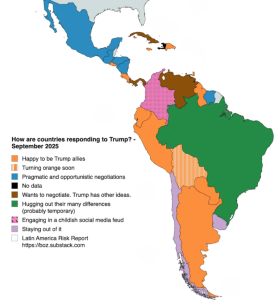
James Bosworth, whose analysis I usually respect, though the narrative tends to be too Western-biased, drew up a parody map that holds a truth: the Trump administration is forcing every government in the region to take a side.
You are with us or you are against us. Or, more accurately, you follow the U.S. interests or the U.S. will make you follow them. A clear pattern emerges when we survey the region. With the arrival of the Trump administration, Latin America is changing its politics, and if necessary, its politicians.
Mexico has been negotiating and ceding to Trump, especially in curtailing immigration and stepping up its effort against drug trafficking. It has also conceded by raising tariffs on China’s imports, probably the U.S. biggest concern. Sheinbaum has been careful not to antagonize Trump, and her administration has insisted that it is collaborating with the Trump administration. That is why when Trump declared cartels to be terrorist organizations, I wrote that it was probably not to be used against Mexico.
The rest of Central America generally falls under the U.S. designs, with the exception of Nicaragua, where Trump has not paid much attention but is threatening to impose new sanctions in the form of tariffs, citing “human rights abuses.” El Salvador and Panama deserve special mention. Bukele is a Trump favorite. He’s accommodating Trump’s needs and therefore receiving preferential treatment. Panama, on the other hand, was forced to expel China from ports on the Canal under the threat of invasion and to offer preferential treatment to U.S. military vessels.
The Caribbean at the moment is dominated by U.S. military presence and by illegal attacks against boats allegedly carrying drugs, without presenting evidence. However, only about 10% of maritime drug trafficking occurs through the Caribbean while 80% occurs through the Pacific. If Trump really wanted to stop it, he is looking on the wrong side of the water. The purpose, of course, was not that, but to show “strength” and pressure Venezuela and now, Colombia.
Beyond these two countries, to which I will return shortly, Marco Rubio has made sure to use all possible leverage against Cuba, reinstating it as a country that sponsors terrorism. He has imposed even more sanctions and is impeding other countries, like Russia and China, from coming to its assistance. The electricity shortages that are putting significant stress on the population could be understood as an effect of that pressure. The U.S. is also taking measures in Haiti, and the Dominican Republic’s president is a close collaborator.
Noboa, Ecuador’s president, was elected in February and has already planned a referendum to change the constitution and allow foreign military bases, i.e., U.S. military bases, in the country. He was elected amidst an intense security crisis that has overrun the country over the last seven years. Ecuador went, suddenly, from being one of the most peaceful countries in Latin America to one of the most violent, and in the process it elected a Bukele-style president.
Peru has just replaced its hugely unpopular and unelected president and is now facing strong protests. Last year, Peru inaugurated a deep-water port, part of the Chinese Belt and Road Initiative and developed by the Chinese state-owned company Cosco. The U.S. was not happy about that. Early next year there will be elections, and it is probable that the country will elect a candidate that promises to deal strongly with violence in the style of Noboa and Bukele.
Chile will have elections sooner, in November 2025, and most probably a right-leaning candidate will emerge as president, moving the country away from the left-leaning current president Gabriel Boric. Bolivia has just elected its new president, Rodrigo Paz, who has promised “capitalism for all.” The day after the elections he promised to reestablish relations with the U.S. and vowed support for Venezuela’s regime-change leader, Corina Machado.
What seems to emerge from this quick survey is that Latin America is moving away from the “Pink Tide” that washed over the region towards the end of the last century and the beginning of this new one and is moving toward an “Orange (Trump) Tide.” Now, of course, coincidence does not necessarily imply causality, but it’s definitely something to ponder — how this correlates with a move towards a more authoritarian government in the U.S., a marked end of hegemony, and a revival of the concept of spheres of influence. Especially given the fact that the CIA has historically been — and continues to be — very busy in the continent.
The three countries that most strongly resist U.S. interference in their internal affairs are Brazil, Colombia, and Venezuela. Brazil has been involved in a standoff against the U.S. since, at least, August 2024, when a Brazilian judge banned X because Musk did not want to comply with the country’s disinformation rules. The allegations were that X had reinstated accounts tied to the alleged 2022-2023 coup plot that involved former president Jair Bolsonaro.
When Trump became president for a second time, he lashed out against the Brazilian government trial—and conviction—of Bolsonaro, his former ally, trying to pressure Lula through tariffs to let him go free. Lula did not cede and defended the judiciary’s actions, which has led to the current tensions. Though they allegedly hugged at the UNGA, I suspect that was Lula trying to copy Sheinbaum’s approach rather than a true rapprochement. Trump is also not happy that Brazil is a founder of BRICS and that Lula has openly called for de-dollarization. But, more importantly, Brazil is strengthening its economic relations with China.
Like in Brazil, since Trump came to power he has criticized Colombia’s process against former president Alvaro Uribe, who has been accused of bribery and witness tampering. The High Court has overruled the sentence and Rubio expressed his satisfaction with that. Uribe was president for 8 years, coinciding with the implementation of U.S. Plan Colombia.
Since 2000, with Plan Colombia, this country has been the largest recipient of U.S. aid and its closest ally in the region. But the arrival of Gustavo Petro, the first leftist president and declared socialist coming from a former guerrilla group, has upended these relations. Petro has been extremely critical of the U.S. policies in the region, especially the ones to combat drug trafficking, which he claims have killed over a million people. His proposal for fighting drugs involves offering economic alternatives to the poor and has clashed with the U.S. model. He also strengthened cooperation with China, positing Colombia as part of the Belt and Road Initiative.
Petro has also been extremely critical of the U.S. deployment in the Caribbean, saying that attacks on boats are illegal and that the extrajudicial killings are crimes against humanity. He’s openly said that the U.S. intends regime change in Venezuela and that it wants Venezuela’s natural resources. This has led to Trump issuing serious threats, cutting aid funding, threatening sanctions, and accusing Petro of producing drugs. If we take Venezuela’s example, this is a step prior to authorizing the CIA to operate in the country.
Venezuela, of course, is the U.S. main antagonist in the region, but only because the U.S. has decided it is so. Maduro is more than willing to trade and sell oil to the U.S., as shown by Chevron licenses even in the midst of heavy sanctions. The U.S. could, technically, have access to Venezuela’s vast natural resources without the need to launch an assault on the country. But it could not own them, either directly or through U.S. corporations. That is the result of Chávez’s Bolivarian Revolution, which nationalized all natural resources and established a socialist-style democracy.
These are two things that the U.S. cannot tolerate: a political system and economic model that challenges the U.S. While doing so, Chávez, and later Maduro, became close collaborators with China, Russia, and Iran. It is understandable then that the U.S. would want to make an example of Venezuela for the rest of the region if it wanted to signal that it considers Latin America its sphere of influence.
In sharp contrast to Venezuela stands Argentina’s Milei, who, since coming to power almost two years ago, has taken upon himself to remake Argentina’s socioeconomic model into a neoliberal one and to stand shoulder-to-shoulder with the U.S. in almost every foreign policy issue, including Israel’s war in Gaza. Milei has praised Trump’s effort to reform the international economy and Israel as “the bastion of the West” and has vowed unequivocal support. I would not consider it a coincidence, either, that Colombia, Brazil, and Venezuela have been the most vocal opponents of Israel’s actions in Gaza.
Scott Bessent has stated that Argentina is a “systemic ally” of the U.S. and that is why it is receiving help. But it’s difficult to argue in what practical sense that is the case. Argentina’s agriculture competes with the U.S. in various things, chief among them soybeans and beef. This has led to U.S. farmers complaining about the bailout. Argentina is not a close neighbor and, other than lithium and some silver, does not have large mineral resources. Nor is it a significant trade partner.
But, maybe, that is exactly the reason. The Trump administration seems to be implementing its own flavor of reward-and-retribution policy. For Argentina, it’s reward. If you are a country that does not have a lot to offer in terms of trade or resources but you follow U.S. interests, both practical and ideological, then the U.S. will have your back. For Venezuela, it’s retribution. If you dare to challenge U.S. dominance and put your national interests above those of the U.S., even if you are a country rich in resources, the U.S. will try to bring you down. This basic logic seems to explain U.S. policy in Latin America.