
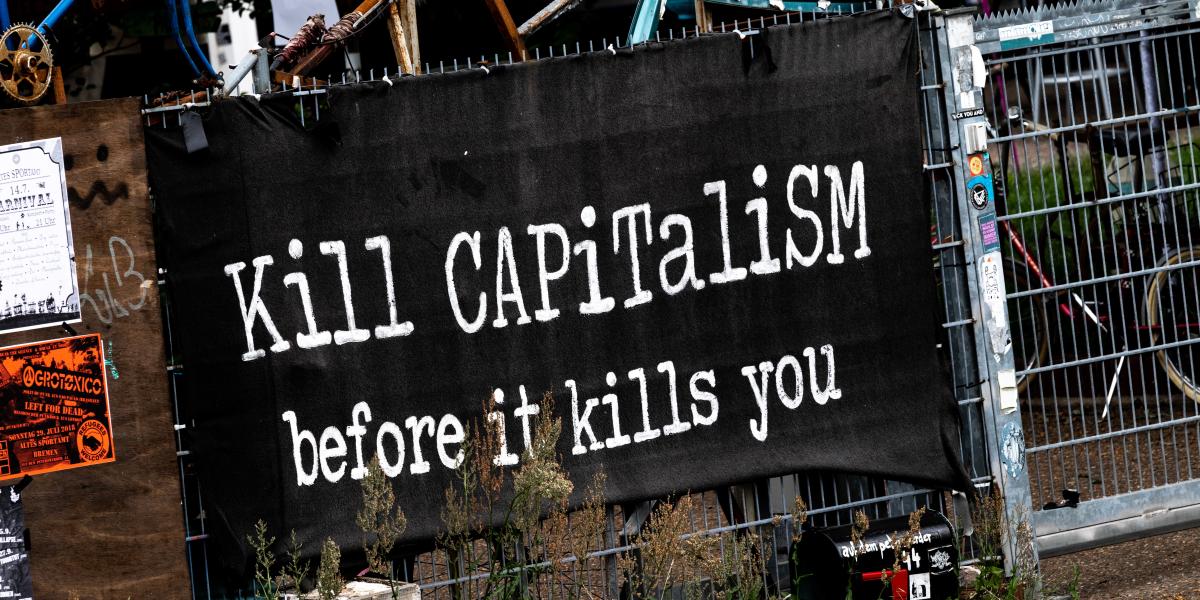
In light of recent developments in New York City, specifically on the recent primary elections and the emergence of self-described democratic socialist Zohran Mamdani as a potential mayoral candidate, as well as the increasingly aggressive public engagement of Bernie Sanders and Alexandria Ocasio-Cortez in their tour around the United States, and the fact that AOC’s chances of becoming the 2028 Democratic presidential nominee have doubled within one week, it has become clear to me that socialist rhetoric is gaining momentum in American political discourse.
This trend is further reflected in survey data from the Pew Research Center, which shows that approximately 36 percent of U.S. adults aged 18 to 29 now view socialism positively. In response to these developments, it is imperative to contribute to the proper education and clarification of what these socialists are actually advocating for, or even what true socialism truly advocates for.
Friedrich von Hayek, Nobel laureate and one of the most influential economists and political philosophers of the 20th century, once remarked, “If socialists understood economics, they wouldn’t be socialists.” Building on his erudition, I would add: If socialists understood socialism, they wouldn’t be socialists.
The true definition of socialism is a social and economic doctrine that advocates for public, rather than private, ownership or control of property and natural resources—the means of production. It is both a political and economic system in which the means of production are owned and controlled collectively by the community or the state, rather than by private individuals. In other words, in practice, the means of production are controlled by a minority political elite.
Now, no matter whether an economic system is capitalist, socialist, or any other, it is important to note that the system itself is not a utopia or an end in and of itself, but a means to an end. Economic systems ration scarce resources, goods, and services, and each one does this through either a private or a social decision-making process, but only individuals can truly make decisions. Modern money economies operate on prices which reflect the value assigned by either individuals or groups, as well as supply and demand. However, who gets to decide what is supplied and what is demanded differs across these systems. Socialism claims that shared ownership will foster broader participation, leading to everyone sharing in the benefits. Although this is impossible, it remains the foundational argument.
Many socialists have bypassed the foundational principle of collective ownership of production and have instead jumped straight to demands for ownership or redistribution of the output of production. Production is seemingly taken for granted. This conceptual shortcut makes socialism seem like a dream economic system by avoiding what socialism really is.
Therefore, although many public and political arguments are made in the name of socialism, what is often advocated for is not true socialism. In reality, the debate has rarely centered on collective ownership of the means of production—such as the factories, tools, land, and capital that make production possible—but instead on ownership or control of the outputs of production (goods and services). Simply put, many self-identified socialists are less interested in owning the means of production and more interested in claiming entitlement to what is currently being produced or the production that someone else already owns. Thus, the economic system debate is rarely about who controls the means of production itself but rather about the redistribution of final goods and services.
This desire for control over what is produced—rather than the means of production itself—is evident in many policies, programs, and agendas often associated with socialism. These initiatives frequently call for “free” goods and services (although, in reality, nothing is ever truly free, as someone always bears the cost and goods must be produced).
Examples of such policies include socialized healthcare, public housing, state-owned utilities, welfare and unemployment benefits, rent control, and progressive taxation aimed at being provided by the redistribution of wealth. What these policies have in common is a focus, not on who owns or manages production, but on how the final outputs are distributed. This raises an important question: Are socialists really interested in the means of production?
The application and results of these socialist policies have proven otherwise. These so-called socialist policies do not truly advocate for the collective ownership of the means of production, but rather for control over the final products of production. The only “means” of production that is regularly targeted for redistribution is capital in the form of money, but even this is not desired for its own sake. What people ultimately seek is not money itself, but the actual outputs of production, or, put more plainly, the goods and services that money can buy. In this sense, many modern redistributive policies function, not by socializing production, but by reallocating its results.
A common argument made in defense of modern socialist policies is that there are too many multi-billionaires, and then there are the rest of us. The implication is that no one needs that much wealth and that it should be redistributed, often without regard for how that wealth was earned. Many have concluded that they somehow have an inherent personal right to someone else’s wealth. But I ask the same question Thomas Sowell asked many years ago: What is your “fair share” of what someone else has worked for? Further, Sowell has also said, “I have never understood why it is ‘greed’ to want to keep the money you have earned, but not greed to want to take somebody else’s money.”
In any case, let us entertain the socialist argument that wealth should be distributed. It is often framed as a moral critique of the “haves” and the “have-nots”—that those who have simply have too much, and that if only the have-nots had what the haves have, they too could be successful or “rich.” A common example involves a single parent struggling to meet basic needs, or a poor college student or recent graduate trying to get started, which is a sympathetic and often-used illustration of inequality. (Of course, this overlooks the universal reality that everyone has unmet needs to varying degrees, and that such needs are inherently subjective).
Let us ask a more precise question: Do these single parents or recent college graduates want ownership of the means of production—the land, machinery, raw materials, and complex processes involved in creating goods and services? Or do they simply want more of the outputs—more goods, more services, more income—ideally provided at someone else’s expense? This is the crucial distinction. The socialist argument is not about democratizing production—it’s about redistributing consumption. And that is a fundamentally different conversation from what traditional socialism proposed initially.
Even when the argument shifts to wealth, the esteemed economist Thomas Sowell challenges its underlying premise, stating: “There is a crucial question as to whether the redistribution of income or wealth can actually be done, in any comprehensive and sustainable sense.” Sowell cites the expulsion of the Jews from Spain near the end of the 15th century. As often happens when a group is forcibly removed, the Jews were not allowed to take their material wealth with them. However, they carried with them something far more valuable—their skills, knowledge, and cultural capital. Over time, many of these Jewish communities rebuilt their lives and raised their standard of living wherever they resettled, particularly in the Netherlands. While Spain may have once benefited from the wealth that was left behind, it now lags behind most of its Western European peers in both GDP per capita and productivity.
This historical example illustrates a critical economic principle: you can redistribute existing wealth, but not necessarily the capacity to create wealth. Sowell also references a case study in Detroit, where policy and regulatory changes led to the departure of a significant portion of the city’s skilled population. Despite the factories, machines, and infrastructure being left behind, those who remained lacked the know-how to operate or maintain them effectively. As a result, the inherited wealth deteriorated. Sowell’s conclusion is clear: confiscated wealth eventually wears out, and those who inherit it without the capacity to use or sustain it will struggle to preserve it, let alone grow it. This is because redistributive efforts deter future innovation by signaling to potential wealth creators that they may not be allowed to retain the fruits of their labor.
This is what happens when people confuse money itself with capital—treating it as the part of production that can be redistributed—without recognizing that money only has value when there is something on the other side of the transaction to purchase. Wealth only has long-term value when it is combined with the entrepreneur’s knowledge, skills, time, risk-taking, and coordination. It is not money alone that drives production and wealth, but rather the combination of numerous other factors.
























