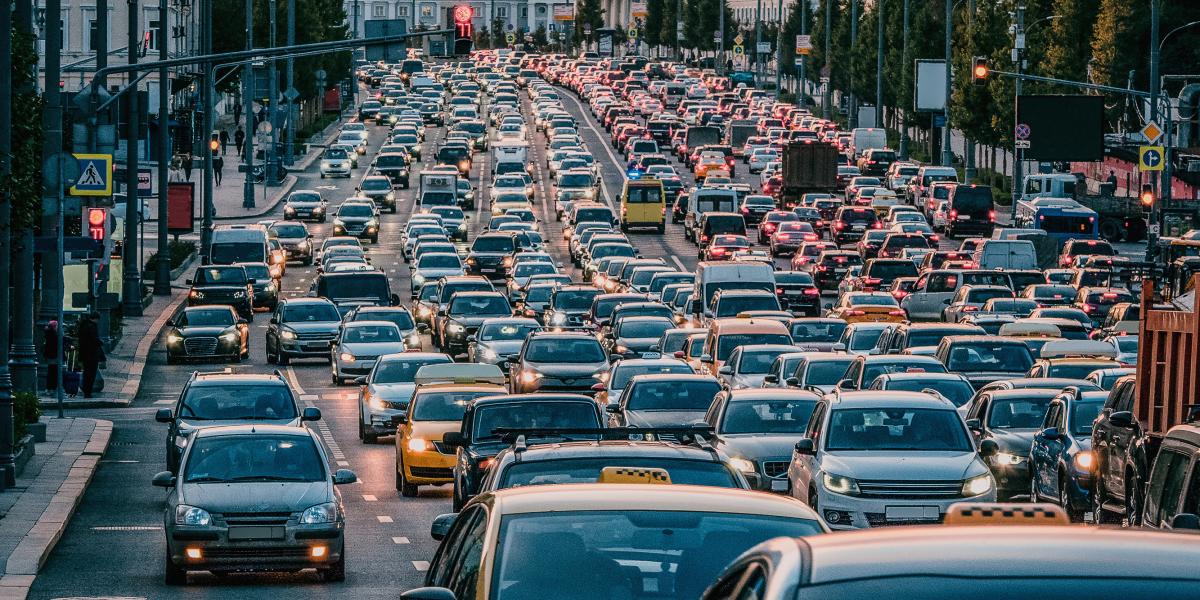
The dreaded question that every self-identified libertarian has to face is the infamous, “Without the government, who would build the roads?” I have dealt with the roads objection at further length in a past paper (as have many others). It is what I call a “statist non sequitur,” that is, a problem to which the state is assumed to be the only solution. It is also an ignorance/imagination-failure fallacy—that lack of knowledge concerning how something would work implies that it is impossible without the state. However, the question of this article is, without government roads, what would traffic look like?
Roads Are Not Special
Roads are not special; they are not some magical, exceptional good beyond the scope of economic law. While there are particularities of every business (e.g., getting perishable fruit to market), production and exchange of roads has to do with questions of supply and demand, economic calculation, competition, and profit and loss. In other words, what is the right amount of roads relative to consumer demand?
Even some more mainstream economists (cited in Block) acknowledge that basic principles of economics could be applied to roads and that failure to do so results in inefficiencies. For example, Gabriel Roth in Paying for Roads—The Economics of Traffic Congestion, wrote (p. 16),
…[T]here is a[n] approach to the problem of traffic congestion—the economic approach—which offers a rational and practical solution…. The first step is to recognize that road space is a scarce resource. The second, to apply to it the economic principles that we find helpful in the manufacture and distribution of other scarce resources, such as electricity or motor cars or petrol. There is nothing new or unusual about these principles, nor are they particularly difficult. What is difficult is to apply them to roads, probably because we have been brought up to regard roads as community assets freely available to all comers. (emphasis added)
O.H. Brownlee and Walter W. Heller, in “Highway Development and Financing,” American Economic Review (May 1956), basically touch on issues of economic calculation under bureaucratic conditions, “Our rationing and construction criteria make it difficult to evaluate the highway system and plans for future development according to the economic criteria one would wish to apply.” They acknowledge that the non-market nature of the system stymies application of supply and demand. They continue,
The highway situation can be improved substantially by visualizing the similarities between the highway problem and a host of comparable problems to which economists have applied some rather ancient ideas: namely, those of “good old supply and demand analysis.” (emphasis added)
David Winch in The Economics of Highway Planning (p. 141) recognized that all the same foundational and basic economic principles also apply to roads,
The provision of highways involves basically the same problems as any other economic activity. Scarce resources must be used to satisfy human wants by the provision of goods and services, and decisions must be made as to how much of our resources will be devoted to one particular service, and who is going to make the necessary sacrifice. (emphasis added)
Public Goods: The Bifurcation between Revenue and Service
Like other goods and services, there is a demand for road services. Road entrepreneurs—like all other entrepreneurs—would have to employ economic calculation to determine the costs of inputs in money prices, purchase and arrange factors to create roads, and offer the service to consumers at a price that both attracts consumers and earns a profit. Similarly, they would have to do this within the context of competition and with attention to consumer feedback—problems, safety, convenience, etc. As Walter Block explains, “The road entrepreneur would have to try to contain congestion [traffic], reduce traffic accidents, plan and design new facilities in coordination with already existing highways, as well as with the plans of others for new expansion.” In this case, there would still be problems and some level of traffic, however, the firms must be responsive to consumer feedback because they depend on continued patronization for their revenue.
This is the simple, but profound, insight of Mises’s Bureaucracy—private enterprises must satisfy consumers to earn revenue through voluntary patronage, whereas government bureaucracies and/or government-contracted companies receive revenue from coercive taxation, therefore, the service they offer is fundamentally disconnected from the voluntary choice of the consumer. A private firm offers goods to consumers who provide direct and unignorable feedback through the choice to voluntarily purchase it or not. A private firm cannot survive without profits. Losses demonstrate that an entrepreneur or firm has failed to arrange factors of production in a way that pleases consumers. In that case, they must either adapt or go out of business. The connection between the service and the revenue is direct.
In contrast, when a government coercively taxes citizens, gives a bureaucracy a budget (which is incentivized to expand), and then the bureaucracy either creates a service or offers a contract to private companies to provide the service (inviting cronyism), the service is disconnected from the consumer who has already been required to pay for it. Lacking profit and loss, such providers have no feedback mechanism concerning how much to supply relative to how much consumers demand. Further, there is little to no competition in this process (though the free market sometimes provides competitive alternatives to state-provided services). Even assuming the best intentions, market decisions become political decisions. Hence, when governments and/or government-contracted road-building companies provide roads, economic calculation cannot be used to determine the right supply relative to demand; if supply is too low, then traffic congestion is one result.
Again, as quoted previously, economists Brownlee and Heller said in 1956, “It is common knowledge that highway development has not kept pace with the growth in vehicle numbers or miles traveled on the highway.” More vehicles and more people on the roads means more traffic. Unfortunately, instead of a responsive market solution to issues of supply and demand, most simply call for more funding to create more roads.
Rothbard elucidated that all government operations have this inherent and insoluble problem—the service provided is disconnected from the revenue collected:
The resources needed to supply the free governmental service are extracted from the rest of production. Payment is made, however, not by users on the basis of their voluntary purchases, but by a coerced levy on the taxpayers. A basic split is thus effected between payment and receipt of service. This split is inherent in all government operations. (emphasis in original)
This—not bureaucratic incompetence or evil—is the key economic issue in government services. It is not that a government cannot coercively extract and spend money to build a road or contract a private company to build a road. When, however, the service is disconnected with payment, the market mechanisms of prices, opportunity costs, economic calculation, supply meeting demand, and profits are removed. The service provider receives revenue whether the consumer benefits or not. There is no rational way to calculate demand for how much road should be supplied.
Given that government services are often monopolies or oligopolies—even when private companies are contracted—they are immune from competition putting them out of business and, even if meaningful feedback is provided regarding quantity and quality, revenue is never dependent on responsiveness. For example, will the government or company it contracted to build a freeway take your Yelp review seriously? Can you refuse to pay for it or switch to another provider? Will a government-contracted road-building company know or care that there are not enough lanes? Who is responsible for the deaths or injuries that take place on these roads? Therefore, much of the traffic we observe and experience is because bureaucracies cannot calculate the supply of roads to meet the demand for roads. Market decisions have been replaced with arbitrary political decisions.
Thinking of the traffic you experience, consider Rothbard’s next quote and how it applies:
Many grave consequences follow from the split and from the “free” service as well. As in all cases where price is below the free-market price, an enormous and excessive demand is stimulated for the good, far beyond the supply of service available. Consequently, there will always be “shortages” of the free good, constant complaints of insufficiency, overcrowding, etc. An illustration is the perpetual complaints about…traffic jams on government-owned streets and highways, etc. In no area of the free market are there such chronic complaints about shortages, insufficiencies, and low quality service. (emphasis added)
Rothbard provides an example where the New York City subway system sought to manage excessive demand raising fares. Ironically, the higher fares drove many to buying and driving their own cars instead “thus aggravating the perennial traffic problem (shortage of government street space) even further.” Rothbard identified the fact that stubborn scarcities and conflicts keep appearing in government services: “juvenile delinquency, traffic jams, overcrowded schools, lack of parking space, etc.”
It is not just the bifurcation of payment and service, but several other government policies contribute to aggravated traffic. For example, while we could add many more regulations, consider zoning laws and rent control. In a paper entitled “The Effect of Rent Control on Commute Times,” Krol and Svorny write, “we confirm that it is a lack of household mobility that is behind the longer commutes…. The most restrictive [rent control] ordinances have the strongest effect on commute times.” Because of the housing misallocation from rent control, people either cannot afford to live in certain areas or they find no housing available to them in the vicinity of their work. This leads to longer commute times. With more people on the road and without readjustment in the supply for roads, this added to traffic. This is a perfect example of how one policy can have unintended consequences in areas thought to be totally unrelated.
One Brief Story
For one “peak season” (Thanksgiving–Christmas) I worked as a personal vehicle delivery driver for UPS. Some of my deliveries brought me back to a road I used to drive on growing up and in college. However, since that time, a simple change had been made that worsened traffic considerably between a few lights—a four-lane road (two lanes each direction) was reduced to a two-lane road. Two of the former lanes were now designated for bicycle traffic, however, this was not a market-driven decision based on the high volume of bicycle traffic (which was minimal), but by a political decision.
And, if you happen to have great success by engaging in the voluntary production-and-exchange process—after being taxed to pay for roads, waiting in government-inflamed traffic, navigating a complex and costly regulatory environment—remember that certain government elites will claim credit, argue for higher taxes, and claim that your success is not your own because—when it comes to the roads—“You didn’t build that!”